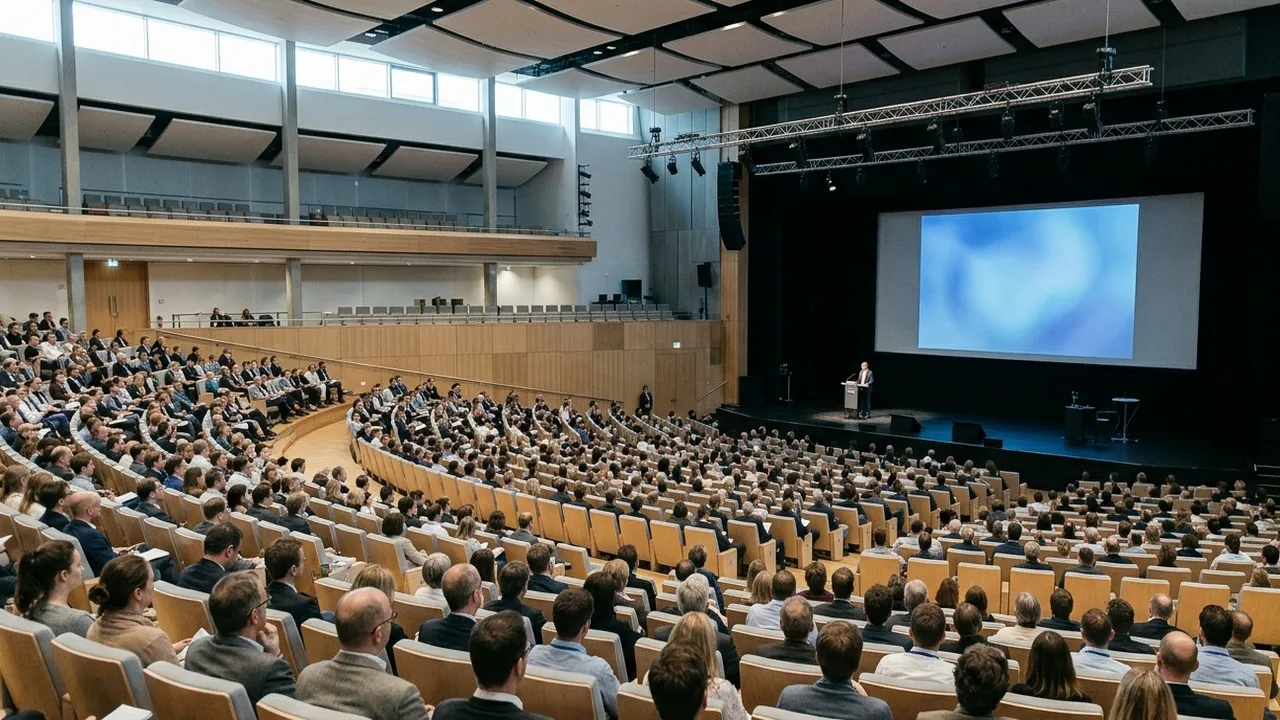
It is 2.40 pm on the second day of an association congress. Five panellists sit on high stools, and the moderator opens with “Perhaps you could each say a few words about yourselves.” The third introduction is still running at minute fourteen. In row six, a member checks her emails. When the floor finally opens, there is time for one question, and it turns out to be a statement.
The speakers may all be capable, but the session was poorly planned weeks before they took the stage. A panel often loses its audience because of its structure. Three or four distinct perspectives, a clear point of disagreement and audience questions from the start can turn the same slot into a useful starting point for further conversations. This guide shows you how to build it.
What is a panel discussion?
A panel discussion is a moderated conversation on stage in which three to five speakers with different perspectives discuss one topic in front of an audience, usually for 45 to 60 minutes. A moderator asks the questions, keeps the airtime fair and brings in questions from the audience. The panellists do not give presentations. They answer, react to each other and, ideally, disagree in public.
Exploring those differences is the format’s main strength. One expert with a strong view is a keynote. One guest in depth is a fireside chat, and if you are weighing that option, our guide to hosting a fireside chat explains when one voice is enough. If everyone in the room should speak, not only the people on stage, you need a roundtable discussion instead. A panel earns its slot when the audience gets to watch several informed people weigh the same question differently.
Why panels bore the room, and why that is fixable
That contrast with other formats is also where the panel’s reputation problem starts. In the Walls.io Event Engagement Index 2026, a survey of 102 regular event attendees in February 2026, 57 per cent named networking with peers as their main reason to attend. Only 25 per cent came mainly for talks, panels or workshops. Nine out of ten said they expect to take an active part rather than sit and watch.
The sample is small, so treat the findings as an indication rather than a general benchmark. RainFocus benchmark data shows sessions attended per person falling from 5.3 in spring 2025 to 4.2 in spring 2026, while meeting participation grew. Forrester’s Q1 2026 survey of 400 event decision makers found that two in three organisations plan more workshops, roundtables and structured networking.
For your programme, the consequence is simple. Attendees will still sit through a panel, but not one that feels like four short keynotes in a row. A panel has to offer something as valuable as the conversations outside the room. It does so by giving attendees ideas they want to discuss afterwards.
That is the real job of the format. Build the session around contrasting views and invite audience participation early. It becomes the reason people approach each other at the next break.
How many people should be on a panel?
Start by deciding how many panellists the session needs. Three or four panellists plus a moderator is the range that works for a 45 to 60 minute slot. Five is the upper limit. The reason is arithmetic.
Take a 45 minute panel. Welcome and short introductions use four minutes, audience questions need twelve, and the close takes two. That leaves 27 minutes of moderated conversation. The moderator’s own questions and transitions take about five of those. The remaining 22 minutes are shared between the panellists.
Airtime per panellist
How much each panellist gets to say in a 45 minute panel
Assumes 4 minutes of welcome, 12 minutes of audience questions, 2 minutes of close and about 5 minutes of moderator questions.
With six panellists, each person gets roughly two answers. That is not enough to build an argument. With three, each panellist can make a point, defend it and change their mind on stage, which is the moment audiences remember.
Requests for extra panellists often reflect stakeholder commitments rather than the needs of the discussion. Picture the programme lead of a national trade association. A board member asks for one seat per regional chapter, a sponsor wants a speaker, and the ministry has confirmed a guest. That is six people before anyone has asked what the panel should argue about. The better answer is two panels with different questions, or one panel and one fireside chat. Both options give each speaker more room to contribute.
Panel roles: moderator, panellists and audience question coordinator
Once the number of chairs is set, three roles decide whether the session works.
- The moderator: represents the audience, not the panellists. Prepares the arc, asks the questions, keeps the airtime fair and cuts off speeches politely. A good moderator speaks perhaps 15 per cent of the time and is never the fifth panellist.
- The panellists: bring different positions, not just different job titles. Three people from similar companies may share the same views, leaving little for the audience to weigh up.
- The audience question coordinator: one person off stage who watches the incoming audience questions, groups similar ones and passes the best to the moderator. At a larger event this is often someone from your programme team.
Choose speakers for the perspectives they bring. A useful test is this: can you name one question on which two of your panellists will give opposite answers? If not, keep looking. Our guide on how to get speakers for your B2B conference covers where to find people who bring a real position.
How to prepare and brief a panel
Once the casting is settled, the briefing turns a group of individuals into a conversation. Most of the work happens in one call, two to three weeks before the event.
Preparation
From booking to stage in six steps
- Step 1 Define the question One question the panel will answer, not a topic. It goes into the programme.
- Step 2 Cast for difference Three or four people who will answer that question differently.
- Step 3 Hold one briefing call All panellists and the moderator together, 30 to 45 minutes, two to three weeks before.
- Step 4 Agree the arc Three topic blocks in a fixed order. Panellists know the topics, not every question.
- Step 5 Collect early questions Ask registered attendees what they want to know and share the themes with the panel.
- Step 6 Meet before the stage Fifteen minutes backstage: seating order, microphones, signals for time.
The joint briefing call is the step most often skipped. Panellists who meet for the first time on stage spend ten minutes being polite to each other. If they have already found their disagreement, they can start there.
Agree two rules in that call. First, no slides. A panel with slides becomes a series of presentations. Second, no long biographies. The moderator introduces each panellist in one sentence that explains why their view matters for this question. The full bio belongs in the event app.
Panel questions that do not bore the room
The briefing fixes the topics. The questions decide whether the answers will differ. Good panel questions ask for decisions, experiences and disagreements, not for opinions on trends. “What do you think about the future of membership?” invites four similar answers. “Which member benefit would you cut tomorrow, and why?” invites four different ones.
A few patterns work reliably:
- Ask about a decision: “What did you change in the last year, and what did it cost you?”
- Ask about a mistake: “What did you believe about this two years ago that turned out to be wrong?”
- Set up the disagreement: “Anna says the annual congress should shrink. Tom, you are planning the opposite. Why?”
- Ask for the practical step: “If someone in this room wants to try this next month, what should they do first?”
Avoid asking every panellist to answer every question in turn. By the third response, the discussion often becomes repetitive. Toastmasters Magazine recommends preparing up to ten short questions, at least one per panellist, and knowing the first and last in advance. Make the first one concrete, not “tell us about yourself”.
Audience questions from minute one
Prepared questions reflect the moderator’s priorities; audience questions reveal what matters to the room. The classic panel saves audience questions for the last ten minutes. By then, half the room has forgotten what they wanted to ask, and the first microphone goes to whoever stands up fastest. That person often has a statement, not a question.
Open the question channel at the start instead. An app or a simple audience response tool lets people submit questions while the discussion runs and vote on the ones they like. The audience question coordinator groups them, and the moderator can weave the strongest into the conversation as it happens. Our article on what audience response tools can and cannot do explains the options and the data protection questions behind them.
Digital question submission also makes it easier for quieter attendees to contribute. When the live microphone comes out and nobody raises a hand, count to five and move on to a prepared question. A prepared question can keep the discussion moving without putting anyone under pressure.
Timing a 45 minute panel discussion
With the questions in place, the clock decides how much of the plan reaches the room. This structure works for most conference panels of 45 minutes:
| Minute | What happens |
|---|---|
| 0 to 4 | The moderator states the panel’s question and introduces each panellist in one sentence |
| 4 to 15 | First topic block: the concrete opening question and the first disagreement |
| 15 to 27 | Second topic block, with the first audience questions woven in |
| 27 to 31 | Third topic block: what the audience can do next |
| 31 to 43 | Audience questions, grouped and voted on, two or three answers each |
| 43 to 45 | One closing sentence from each panellist and a pointer to what comes next |
Kristin Arnold of Powerful Panels suggests thinking in blocks of eight to ten minutes, because attention drops when one segment runs much longer. A change of speaker, a new block or an audience question resets the room. If your panel sits in a tight programme, write these minutes into your run of show, so the stage manager knows when the moderator gets the five minute signal.
Six mistakes that make a panel boring
Timing problems are usually symptoms. The same six failures show up at conference after conference, and each is easy to spot during planning.
- Too many chairs: five or six panellists, each with two answers. The arithmetic above shows why.
- Introductions that run long: five minutes of biography per person. One sentence each is enough.
- Slides and opening statements: every panellist gets “five minutes to set the scene”, and the panel turns into four keynotes.
- Everyone agrees: no prepared disagreement, so the panel confirms what the room already believed.
- The moderator as panellist: long questions with the moderator’s own view built in, plus a comment after every answer.
- Audience questions only at the end: the last ten minutes, one microphone, and a statement disguised as a question.
The programme lead from the trade association would recognise most of these from her own congress. These problems can usually be addressed through better preparation and clearer moderation.
After the panel: from stage to conversation
A well-planned panel can leave the audience with new questions worth exploring. The audience now knows who holds which view, and the panel has done its real job if those views start conversations. The question is where they happen next.
Picture the end of a strong panel. Three attendees wait at the edge of the stage for one panellist, while the coffee break starts and the next session pulls people away. Two of them have the same question about member pricing and never find each other. That is the gap your programme should close.
Three things help. Schedule a break or networking block directly after the panel. Ask panellists in the briefing call for a short meeting window after their slot. And use the submitted questions: people who asked similar ones are often a better conversation for each other than the panellist is. How to give these windows a fixed place in the day is the subject of our guide to conference agenda planning.
Converve helps you turn that interest into scheduled meetings. Attendees and speakers set up profiles with their role, interests and topics, and you define in a meeting matrix who can request meetings with whom, for example members with panellists or members with members from the same sector. Accepted meetings land in free slots in both agendas, right after the session if you choose. Our solutions for associations show how this works across an annual congress, and if you run a programme of events through the year, our guide to association event management shows how panels and meetings fit into the wider calendar.
Frequently Asked Questions
What is a panel discussion?
A moderated conversation on stage in which three to five speakers with different perspectives discuss one topic in front of an audience, usually for 45 to 60 minutes. The moderator asks the questions and manages the time.
How many people should be on a panel?
Start by deciding how many panellists the session needs. Three or four panellists plus a moderator works best for a 45 to 60 minute slot. In a 45 minute panel, three panellists get about seven minutes of airtime each, while six get less than four, which is too little to make and defend a point.
What does a panel moderator do?
The moderator represents the audience. They brief the panellists, ask the questions, keep the airtime fair, bring in audience questions and close on time. A good moderator talks little and never acts as an extra panellist.
How do you moderate a panel discussion?
Hold one joint briefing call two to three weeks before, agree three topic blocks and one disagreement, introduce each panellist in one sentence, start with a concrete question, collect audience questions from the first minute and end with one closing sentence from each panellist.
How long should a panel discussion be?
Most conference panels run 45 to 60 minutes, with about a quarter of the time for audience questions. A 30 minute main stage panel works with two or three panellists.
What is the difference between a panel and a roundtable?
A panel has a few speakers and an audience that listens; a roundtable has no audience, and everyone at the table is expected to speak. We compare the two formats, plus workshops and breakouts, in our guide to the roundtable discussion.
Conclusion: plan for a useful discussion
A panel discussion is only as good as its design. Three or four people who disagree, a moderator who serves the audience, questions that ask for decisions and a question channel that opens at minute one: these elements help sustain the audience’s attention. The speakers matter, but the plan matters more.
Make time for the conversations that follow. When the panel ends, your attendees should know who to talk to next and have a slot to do it. To connect your panels with scheduled one to one meetings, get in touch with Converve.