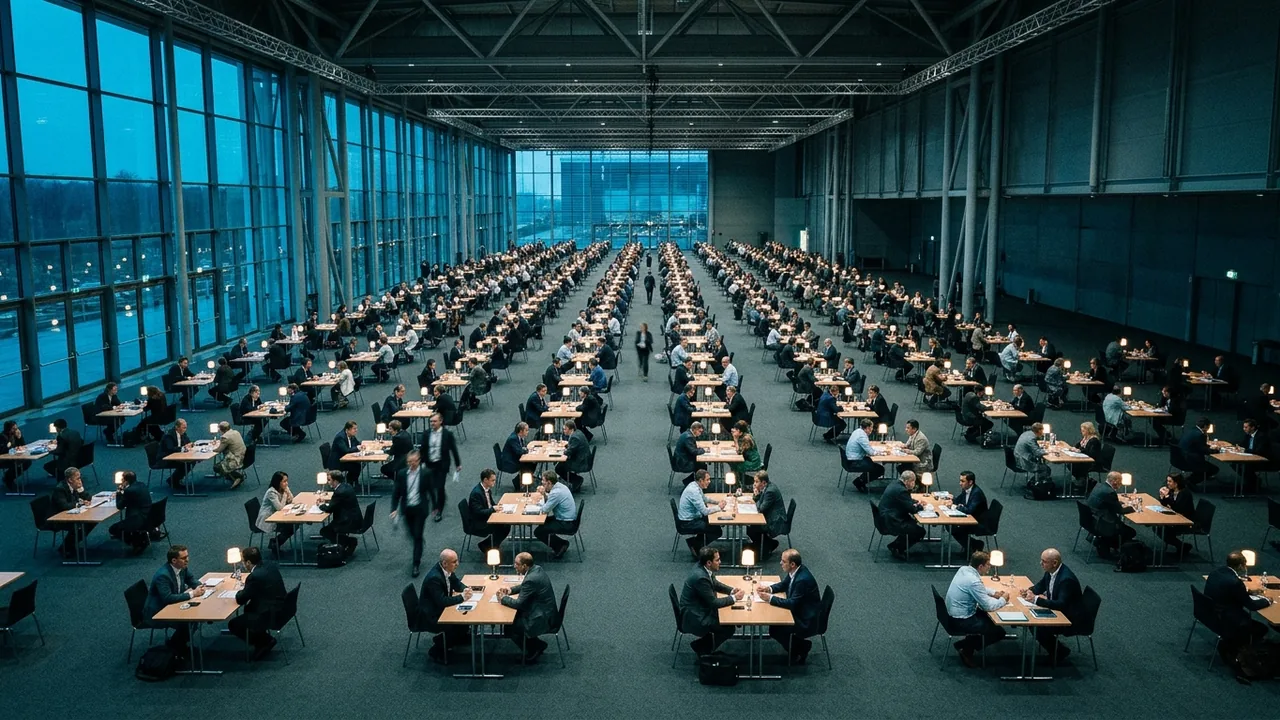
Most hydrogen events have no shortage of people who produce hydrogen, or plan to. Electrolyser makers, project developers and engineering firms fill the halls. The companies that would buy the hydrogen are fewer, busier and harder to get into a meeting. Your programme needs to account for that imbalance when recruiting participants and setting meeting rules.
The International Energy Agency (IEA) puts numbers on it. New offtake agreements were broadly unchanged in 2025, at around 1.7 million tonnes (Mt), and only around 20 per cent of newly signed volumes were backed by firm contractual commitments (IEA, Global Hydrogen Review 2026). Project developers widely report demand creation as a key barrier to investment. For you as an organiser, that sets the brief. A hydrogen partnering event is judged by whether producers meet the offtakers, suppliers and partners their projects still lack. This guide shows you how to plan one along the value chain, with rules that protect the scarce side.
What is a hydrogen partnering event?
A hydrogen partnering event is a programme of pre-arranged one-to-one meetings between organisations along the hydrogen value chain. Participants publish a cooperation profile, request meetings with each other and meet in fixed slots, on site or online. The mechanics are the same as in life science partnering, where biotech and pharma conferences have used profiles, requests, mutual acceptance and short slots for years.
In hydrogen, partnering usually runs alongside a trade fair or a congress. Three recent examples show the range:
- Hamburg, October 2026: the Enterprise Europe Network (EEN) Hamburg/Schleswig-Holstein, based at TUTECH, ran an international matchmaking event alongside the Hydrogen Technology World Expo and the Carbon Capture Technology World Expo from 20 to 22 October 2026. Participants created a cooperation profile and arranged meetings in advance. Taking part was free; the free visitor pass for the fair required a separate registration (TUTECH, 2026).
- Huelva, February 2026: Andalucía TRADE, an EEN member, ran a brokerage event at the third National Congress on Green Hydrogen (H2V 2026) in Spain. Face-to-face meetings from 4 to 6 February were open to registered congress participants. An online week followed for any organisation with an active role in green hydrogen (EEN event page, 2026).
- Stuttgart, October 2025: at the hy-fcell trade fair on 7 and 8 October 2025, EEN and Steinbeis Europa Zentrum ran free B2B matchmaking with Handwerk International Baden-Württemberg and two chambers of commerce, together with Messe Stuttgart (Messe Stuttgart, 2025).
The difference from the trade fair around it is focus. The Hydrogen Technology Expo Europe and Carbon Capture Technology Expo 2025 in Hamburg counted 18,684 visits and 946 exhibitors, with 140 countries represented, according to the organiser’s post-event report. Nobody finds the right three out of 946 exhibitors by walking the aisles. A partnering programme puts those three in the diary.
Why offtake is the gap your programme has to close
A full diary is only useful if the right people are in it. The IEA figures describe a market where technology is available and contracts are not. A project developer can usually choose between several electrolyser suppliers. Finding a buyer who commits to volumes is harder. The IEA’s own conclusion is blunt: offtake agreements remain insufficient to unlock large-scale investment in low-emissions hydrogen production.
The offtake gap in figures
Public funding follows the same logic. In its third auction, the European Hydrogen Bank selected nine production projects in seven countries for around 1.09 billion euros from the EU Innovation Fund, together almost 1.1 gigawatts (GW) of electrolyser capacity (European Commission, 7 May 2026). The auction attracted 58 bids from 11 countries and included a dedicated topic for producers supplying offtakers in the maritime and aviation sectors. Funders, too, want to know who will use the hydrogen.
For you, this means the most valuable participant is often not the largest exhibitor. It is the steelmaker, chemical site, port, shipping line or municipal utility that might sign a supply contract one day.
Picture the programme manager at a regional energy cluster planning her first hydrogen partnering day. She could fill 200 places with suppliers in a week. Her board will ask a different question: how many of those meetings were with someone who might buy? The rest of this guide is built around that question. The missing partner is usually a buyer.
Map the value chain before you open registration
The board’s question can only be answered if registration records roles. Hydrogen projects need partners from very different industries, and each group arrives with a different question.
| Role | Typical participants | What they look for | What they offer |
|---|---|---|---|
| Production | project developers, energy companies, utilities | offtakers, sites, equipment, finance | hydrogen volumes from a planned start date |
| Equipment and components | makers of electrolysers, compressors, tanks and fuel cells | project developers and integrators | technology, delivery slots, service |
| Infrastructure | pipeline and grid operators, storage, ports, refuelling stations | producers and offtakers along a route | capacity, connections, locations |
| Offtake | steel, chemicals, refining, logistics, shipping, aviation, public transport | reliable supply at a price they can plan with | demand, sites, a contract |
| Services | engineering, permitting, certification, legal advice | projects in planning | studies, approvals, compliance |
| Finance and funding | banks, investors, funding agencies | projects with credible offtake | capital, grants, advice |
| Research | universities and institutes | industry partners for pilots and funding calls | test facilities, know-how, people |
Seven roles is enough for most programmes. Turn the table into registration fields, so every profile can be matched:
- Role in the value chain: one main role, plus an optional second one. Many companies sit in two, such as a utility that produces and distributes.
- Project stage: idea, feasibility, permitting, investment decision or operation. A developer at feasibility needs different partners from one in construction.
- Volumes and timing: an indicative range in tonnes per year and a start year, for producers and offtakers alike. Ranges are enough for a first meeting.
- Region or corridor: where the hydrogen is produced or needed, including import routes and ports.
- Seeking and offering: two short text fields, as in any cooperation profile.
Fewer fields get filled in more honestly. Our guide to registration questions for matchmaking explains how to keep the form short without losing what the matching needs.
Matching rules that protect the scarce side
Once roles are recorded, you can decide who may meet whom. In hydrogen the market is lopsided: many suppliers, few offtakers. Without rules, a steelmaker’s energy manager receives 60 requests, declines most of them and stays at home next year. A few rules prevent that:
- Offtakers choose first: open the request window for offtakers and infrastructure operators a few days before everyone else. Their diaries then fill with meetings they chose.
- Caps on outgoing requests: limit how many requests each supplier can send, for example ten. A cap forces suppliers to pick the meetings that matter.
- No supplier-to-supplier slots by default: two electrolyser makers rarely need a matchmaking slot. Exceptions are integrators looking for components.
- Producer and offtaker slots first: reserve the first hours of the day for meetings between producers and offtakers, while everyone is fresh.
- An obligation to respond: ask everyone to accept or decline each request within a few days, so the sender can move on.
How many suppliers one buyer can carry is set out in our guide to buyer to seller ratios at matchmaking events. The same logic applies here, with offtakers as the buyers.
In Converve, you set who may request meetings with whom in a rule-based meeting matrix, using the fields from registration such as role in the value chain, project stage or region. Participants send and accept requests, and accepted meetings land in free slots in both diaries without clashes. Our B2B matchmaking module shows how that fits a partnering day.
From recruitment to follow-up: a partnering timeline
Rules only help if the scarce side turns up. That is why recruitment comes first, long before the request window opens.
A hydrogen partnering day in eight steps
- 10 weeks out Recruit offtakers personally Call steelmakers, utilities, ports and fleet operators directly, ideally through members who already know them.
- 8 weeks out Open registration with roles Profiles capture role, project stage, volumes, region and what each side seeks and offers.
- 5 weeks out Offtakers request first Offtakers and infrastructure operators get a head start of a few days on meeting requests.
- 4 weeks out Open requests for all Suppliers and service providers send requests within their cap. Everyone answers within a few days.
- 1 week out Fix the schedule Remind participants with accepted but unscheduled meetings to open their availability.
- Event day Meet at the tables Thirty-minute slots including the change of tables, plus a few closed rooms for follow-up talks.
- Week after Online catch-up Meetings that did not fit on site take place online, as in the Huelva model.
- 8 weeks after Ask what followed Collect second meetings, confidentiality agreements, site visits, letters of intent and consortia.
Recruiting offtakers is the step most programmes skip. An invitation email to a steel plant’s general inbox rarely reaches the person responsible for energy purchasing. A call from a cluster member who supplies that plant often does. Ask your members which of their customers might use hydrogen, and invite them by name.
Slot length and the number of tables follow the same arithmetic as other B2B formats. Our guide to B2B meetings at events shows how to work out how many meetings a room can hold in one day.
What a first meeting can and cannot cover
The schedule brings the right people to a table. What they say there needs a frame, because hydrogen talks quickly touch commercially sensitive points: prices, volumes, sites and grid connections.
Set expectations before the event. A first meeting works with non-confidential material: a one-pager, an indicative volume range and a planned start date. Prices and contract terms belong in later talks, once both sides have signed a confidentiality agreement. The organiser does not draft those agreements; participants and their legal teams do.
Competitors meet at these events too. Two producers may both talk to the same port authority on the same day. Remind participants not to exchange prices, bids or strategies with competitors, and add that line to your house rules. This is not legal advice; for specific questions, participants should ask their own lawyers.
Two more house rules help: no recording of meetings, and no forwarding of profile documents without consent. Then nobody has to worry about the table next door.
Consortia for EU funding calls
Many hydrogen partnering programmes also serve a second purpose: building consortia for research and innovation calls. The Clean Hydrogen Partnership, the EU’s public-private partnership for hydrogen research, published its 2026 call on 20 January with an indicative budget of 105 million euros across 21 topics. The deadline was 15 April 2026 (Clean Hydrogen Partnership, 2026). Its info day took place in Brussels on 21 January.
The calendar matters more than the format. A consortium needs weeks to agree roles, budgets and work packages, so partner search has to start well before the call opens. A partner found in March is too late.
If your event feeds EU proposals, plan it back from the deadline. How to do that, and how to match the role a consortium is still missing, is covered in our guide to EU brokerage events for partner search.
What to measure and report
Whether a meeting leads to a contract or a consortium, the board’s question comes back after the event. Count the meetings by role pair, not just in total:
- meetings between producers and offtakers, and between producers and infrastructure operators,
- the share of offtakers with at least three meetings,
- second meetings, confidentiality agreements and site visits after eight weeks,
- letters of intent and supply talks that participants report,
- consortia formed and proposals submitted,
- returning participants next year, by role.
The programme manager could then write a sentence like this in her annual report: 34 of 41 offtakers held at least three meetings, 12 producer and offtaker meetings led to a second meeting and two to a letter of intent. That is an answer her board can use. How to collect and present such figures for public funders is set out in our guide to reporting to funders for innovation programmes.
If the partnering day is one event in a cluster’s year, the same members will meet again. Our guide to cluster organisations and member matchmaking shows how to keep those introductions going between events.
Frequently Asked Questions
What is a hydrogen partnering event?
A hydrogen partnering event is a programme of pre-arranged one-to-one meetings between organisations along the hydrogen value chain: producers, equipment suppliers, infrastructure operators, offtakers, service providers, funders and research institutes. Participants publish profiles, request meetings and meet in fixed slots, often alongside a hydrogen trade fair or congress, on site or online.
Who should take part in hydrogen B2B matchmaking?
Every role that a hydrogen project needs: project developers and energy companies, makers of electrolysers and other components, pipeline, storage and port operators, industrial and transport offtakers, engineering and certification firms, banks and funding agencies, and universities. The most important group to recruit is offtakers, because they are the scarcest.
How do you get offtakers to attend a hydrogen matchmaking event?
Invite them personally and early, ideally through members who already supply them. Give them a reason to come: the first choice of meetings, a cap on how many requests each supplier can send and a short, well-prepared diary. An offtaker who spends a day with relevant producers and infrastructure operators is more likely to return.
How long should a hydrogen partnering meeting be?
Twenty to 30 minutes works well for a first meeting, including the change of tables. That is enough to check whether volumes, timing and location fit. Longer talks about prices or contract terms belong in follow-up meetings, often in a closed room or after a confidentiality agreement.
Can hydrogen matchmaking take place online?
Yes. Many programmes combine both. At H2V 2026 in Huelva, face-to-face meetings at the congress were followed by an online week open to any organisation with an active role in green hydrogen (EEN event page, 2026). Online meetings suit international partners and anyone who could not travel.
Why are offtake agreements so important for hydrogen projects?
Without a buyer committed to volumes, many hydrogen production projects struggle to reach an investment decision. The IEA reports that new offtake agreements stayed at around 1.7 million tonnes in 2025 and that only around 20 per cent of newly signed volumes had firm contractual commitments (IEA, Global Hydrogen Review 2026).
Conclusion: make relevant offtaker meetings possible
A hydrogen partnering event succeeds when producers leave with meetings they could not have arranged alone, above all with offtakers. Map the value chain in your registration form, invite offtakers personally and use booking rules to keep requests relevant and manageable. Follow up on the discussions to see what develops.
If you are planning a hydrogen partnering day and want to see how the meeting rules work in practice, get in touch with Converve.