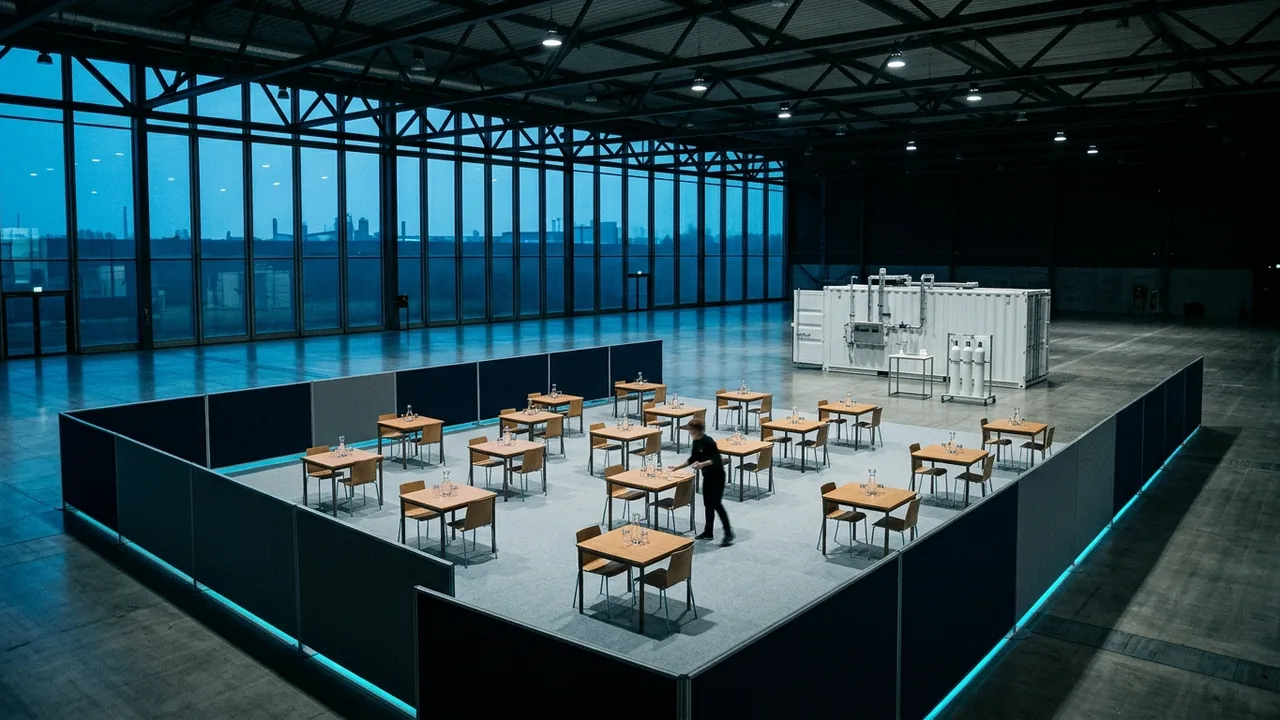
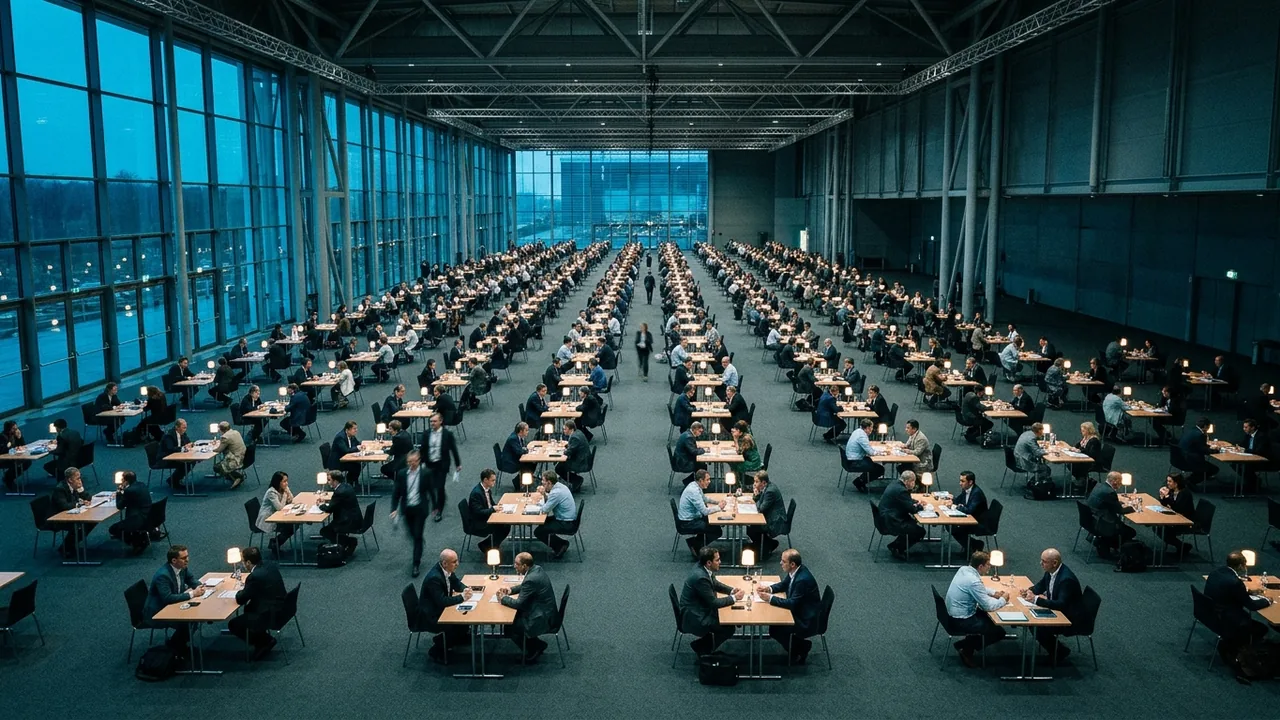
At DSEI, the defence and security exhibition in London, every visitor’s name “will be subject to a security clearance process”, and identity checks are a condition of entry (DSEI UK admission policy). A matchmaking programme in this sector therefore needs to account for admission checks from the start.
Defence industry matchmaking brings prime contractors, their suppliers, SMEs (small and medium-sized enterprises), start-ups and research organisations together in pre-arranged one-to-one meetings. The aim is supply chain partnerships and consortia for programmes such as the European Defence Fund (EDF). What sets the format apart is the order of work. Who may take part, who may meet whom and what may be said are decided before the first meeting request goes out.
This guide is for programme managers at defence industry associations, clusters, chambers and national contact points. It covers the event format and the organiser’s process, not products or technical content. The section on export control is orientation for organisers, not legal advice. Eligibility checks and participant verification are central to the planning process.
Why defence needs its own matchmaking format
Qualification matters so much because the two main groups at the table want different things. A prime contractor integrates large systems and manages a supply chain of many tiers. It comes to scout suppliers, technologies and partners for specific programmes. An SME or start-up comes to get into that supply chain, often for the first time. One side has a few slots and many suitors; the other has one product and few doors.
Governments are pushing hard to open those doors. On 27 January 2026, the UK Ministry of Defence (MOD) launched a Defence Office for Small Business Growth that offers SMEs “networking opportunities with prime contractors”, alongside a target of an additional £2.5 billion of MOD spending with SMEs by May 2028 (UK MOD press release, 27 January 2026). For you as an organiser, that means SMEs arrive with a mandate. They will measure your event by whether they reached the right person at a prime.
In the EU, the funding rules create a second reason to meet. Standard EDF calls require a consortium from at least three Member States or associated countries (Norway and, since October 2026, Ukraine), and the bonus system takes the participation of SMEs and mid-caps into account (European Commission, European Defence Fund). A supplier in Lithuania with the right capability still needs partners in two other countries. Matchmaking is how it finds them before a call closes.
Signals that partner search in defence is growing
Picture the programme manager at a national defence industry association. She is planning a matchmaking day for her members and foreign primes ahead of the next EDF calls. Her board will ask one question afterwards: how many of our members got into a supply chain or a consortium? Everything in this guide is meant to help her answer it.
Who sits at the table, and what each side wants
That answer depends on who registers. A defence matchmaking programme usually has five or six groups, and each one comes with a different goal and a different limit.
| Participant | Comes to | Brings | Typical limit |
|---|---|---|---|
| Prime contractors | Scout suppliers, partners and technology for programmes | Supply chain access, programme knowledge | Few people, many incoming requests |
| SMEs and mid-caps | Join supply chains and consortia | Components, niche capabilities, services | Hard to reach the right contact at a prime |
| Start-ups | Find first customers, partners and investors | New technology, often from civilian markets | Little experience of defence rules |
| Research organisations | Take roles in research consortia | Research capacity, test facilities | Need industrial partners to exploit results |
| End users and procurement agencies | Explain needs and understand the market | Requirements, context | Procurement rules limit what they can discuss |
| Investors | Find companies to finance | Capital, network | Need a clear view of defence market access |
The investor row is growing. The EU Defence Innovation Scheme (EUDIS) runs a matchmaking programme that connects defence innovators with investors, corporates and defence end users, through events across the EU and an online platform; it is open to entities from EU Member States, Norway and Ukraine (European Commission, EUDIS Matchmaking).
The table also shows the imbalance you have to manage. Twenty SMEs may want the same three people from one prime. Without rules, those three people spend the day in back-to-back meetings with companies they would never have chosen, and they do not come back next year. The same problem appears at every event with a scarce group, which is why our guide to buyer to seller ratios at matchmaking events recommends caps on incoming requests for the scarce side.
Qualification before the first request
Caps manage demand. Qualification decides who is allowed to create demand in the first place. In most B2B matchmaking, registration is a form. In defence, it is a check, and the meeting system should only open once that check is done.
Qualification steps before defence matchmaking opens
- Before launch Set eligibility rules Decide which countries, organisation types and sectors may register, in line with the programme or funding rules behind the event.
- Registration Verify organisations Check the legal entity, the country of establishment and, where the programme requires it, ownership and control.
- Registration Verify delegates Confirm each person's identity and affiliation, so participants know who they will actually meet.
- Before opening Review profiles Check that profiles describe capabilities and partnering goals, without technical data or restricted information.
- Opening Open meeting requests Only approved participants can see profiles and send or accept requests.
- On site Check badges Admit only registered and approved delegates to the meeting area, with photo ID.
Each step has a reason in the rules of the sector. Under the EDF, entities from non-associated third countries can take part only under conditions that protect EU security and defence interests, and they receive no EDF funding (European Commission, European Defence Fund). Country of establishment and control are therefore not admin fields. They decide whether a potential partner can join a consortium at all. At DSEI, the organisers state that applicants who give false registration information will have their application denied (DSEI UK admission policy).
Profile review is the step organisers most often skip. Imagine a start-up that uploads its full investor deck, including detailed performance data of a sensor it is developing, to a profile every approved participant can open. Nobody at your event intended harm. The data still left the company in a way its export manager never approved. A ten-minute review before the system opens prevents that.
The badge check is part of the matchmaking.
The fields you need for these checks belong in the registration form from the start, because you cannot add them once profiles are live. Our guide to registration questions for matchmaking shows how to ask for them without turning registration into a questionnaire.
Confidentiality: profiles open, details later
Once participants are verified, the next question is what they say to each other. The answer in defence is close to the one in life sciences: the first meeting is a filter, and it runs on non-confidential material. How partnering conferences handle that in practice is described in our guide to life science partnering.
Two differences make the rule stricter in defence. First, classified information never belongs in a matchmaking programme. Projects that need it run through separate security procedures, such as facility and personnel security clearances managed by national authorities, and those happen long after the first meeting. Second, even unclassified technical information can be controlled, which the next section covers.
As an organiser, you do not write anyone’s confidentiality agreement. You set the frame in which a non-confidential first meeting is the obvious choice:
- Who sees what: profiles and documents are visible only to approved participants, and participants know that before they upload anything.
- What goes into a profile: capabilities, certifications, partnering goals and the role a company wants in a supply chain or consortium. No drawings, test data or source code.
- House rules: no recording of meetings, no photography in the meeting area and no forwarding of profile documents without consent.
- Space for follow-ups: open tables for first meetings, a few bookable closed rooms for companies that already know each other and want to go further.
A clear frame also protects the start-ups. They have the least experience of the sector, so they rely most on yours.
Export control: orientation for organisers
That frame matters because a meeting can itself be a transfer of technology. This section explains why, in general terms. It is not legal advice, and participants remain responsible for their own compliance with their national export control authority, such as the Federal Office for Economic Affairs and Export Control (BAFA) in Germany.
Three rules show the logic:
- Dual-use items in the EU: dual-use items are goods, software and technology that can be used for both civilian and military purposes. The EU controls not only their export but also transit, brokering and technical assistance (European Commission, DG Trade, on Regulation (EU) 2021/821). Technical assistance can happen in a conversation.
- Defence-related products within the EU: transfers between EU countries follow Directive 2009/43/EC, which uses general, global and individual licences, while EU countries set the terms of those licences themselves (European Commission, Defence Transfers Directive).
- US rules on technology: under the US Export Administration Regulations, “any release in the United States of ‘technology’ or source code to a foreign person is a deemed export” (15 CFR 734.13(b)). A technical slide shown to a foreign delegate at an event in the United States can therefore count as an export if it contains technology subject to US rules; defence articles fall under the separate ITAR regime.
DSEI states the consequence plainly for its own visitors: purchasing or brokering exhibits “may require the granting of a strategic export license”, and visitors who engage in controlled business without the relevant licences “may be subject to action” (DSEI UK 2025 admission policy).
What follows for you is practical, not legal. Show each participant’s country and organisation type on the profile, so everyone knows whom they are meeting. Keep profiles at the level of capabilities. Send a short compliance reminder with the meeting schedule, pointing participants to their own export control officer or national authority. Participants stay responsible. Your job is to make the right behaviour easy.
Matching rules for primes, SMEs and start-ups
With qualification and confidentiality settled, the matching itself can stay simple. Most of the work is protecting the scarce side and giving the many a fair chance to be seen.
- Let primes publish their needs: ask each prime for a short list of capability areas it is looking for. SMEs then request meetings with a reason that fits, and primes can decide quickly.
- Cap incoming requests: a cap per prime representative forces choices and spreads meetings across more suppliers.
- Mutual acceptance: no meeting without both sides agreeing. A declined request lets an SME move on to the next prime.
- Decide who may request whom: some programmes let primes and end users send requests to SMEs only, others open requests in both directions. Decide before the system opens.
Programmes built for EDF consortia add an information block before the meetings. At the Nordic EDF Info Day and Matchmaking near Oslo on 28 and 29 January 2026, the first day covered the EDF work programme, national approaches and how to submit a proposal; the second day held three matchmaking sessions (Norwegian Defence and Security Industries Association, final programme). It was part of Enhanced Opportunities for All (EOA), the EDF project whose 17 national partners run matchmaking activities. Planning such an event back from the call deadline works as described in our guide to EU brokerage events.
In Converve, you capture the qualification fields at registration and use them in a rule-based meeting matrix: which groups may request meetings with whom, how many requests each side can receive, and both sides accept before a meeting is scheduled. The B2B matchmaking module is where those rules are set.
What to report after the event
For the report to your board, record both meeting activity and the results that follow. These four measures help show what the programme contributed:
- accepted requests to primes, by prime and by member, to show whether the scarce side was reachable,
- meetings held, by participant group,
- follow-ups reported by participants a few weeks later, such as supplier registrations, non-disclosure agreements or second meetings,
- consortia formed and proposals submitted with a partner met through the event.
The last two depend on a short follow-up survey of participants, not on the platform. Keep it to two or three questions. Our framework of key performance indicators (KPIs) for B2B event matchmaking shows how to collect such figures cleanly. If your association also wants to keep members connected between events, our guide to member matchmaking for cluster organisations covers the year-round side.
Frequently Asked Questions
What is defence industry matchmaking?
Defence industry matchmaking is a programme of pre-arranged one-to-one meetings between prime contractors, SMEs, start-ups, research organisations and, sometimes, end users or investors. Participants are verified before they can see profiles or send requests. The aim is supply chain partnerships and consortia, for example for European Defence Fund calls.
How do SMEs meet prime contractors at defence events?
Through structured meeting programmes at exhibitions, industry days and matchmaking events. Primes publish the capability areas they are looking for, SMEs send reasoned meeting requests, and both sides accept before a meeting is scheduled. Governments support this: the UK MOD’s Defence Office for Small Business Growth, launched in January 2026, offers SMEs networking opportunities with prime contractors.
Why are participants vetted at defence matchmaking events?
Because the sector’s rules depend on who is in the room. Eligibility for programmes such as the EDF depends on a company’s country of establishment and control, and controlled information may not be shared with everyone. At DSEI in London, visitor names go through a security clearance process and identity checks are a condition of entry (DSEI UK admission policy).
Can technical information be shared in a first matchmaking meeting?
First meetings should use non-confidential material, such as a capability overview or a one-pager. Classified information never belongs in a matchmaking programme, and unclassified technical data can still be subject to export control. Detailed information follows later, once both companies have the right agreements and, where needed, licences in place.
Do export control rules apply to meetings and presentations?
They can. The EU controls technical assistance relating to dual-use items, not only physical exports, and under US rules releasing technology to a foreign person in the United States is a deemed export (15 CFR 734.13(b)). Participants are responsible for their own compliance; organisers should remind them and keep profiles at the level of capabilities.
How does matchmaking help with European Defence Fund consortia?
Standard EDF calls need a consortium from at least three Member States or associated countries (European Commission). Matchmaking events held before a call let companies find partners in other countries and test whether they fit. The EDF itself funds such activity: EOA, a project with partners from 17 countries, runs matchmaking to help form consortia.
Conclusion: qualify participants before opening meeting requests
Defence industry matchmaking works when the checks come first. Set eligibility rules, verify organisations and delegates, review profiles before they go live, keep first meetings non-confidential and remind participants of their export control duties. The meeting process can then follow a clear sequence: primes publish needs, SMEs request with a reason, both sides accept.
If you are the programme manager planning a defence matchmaking day, start with the qualification steps, then the matching rules, then the tables. To see how registration fields and a rule-based meeting matrix can support that, get in touch with Converve.