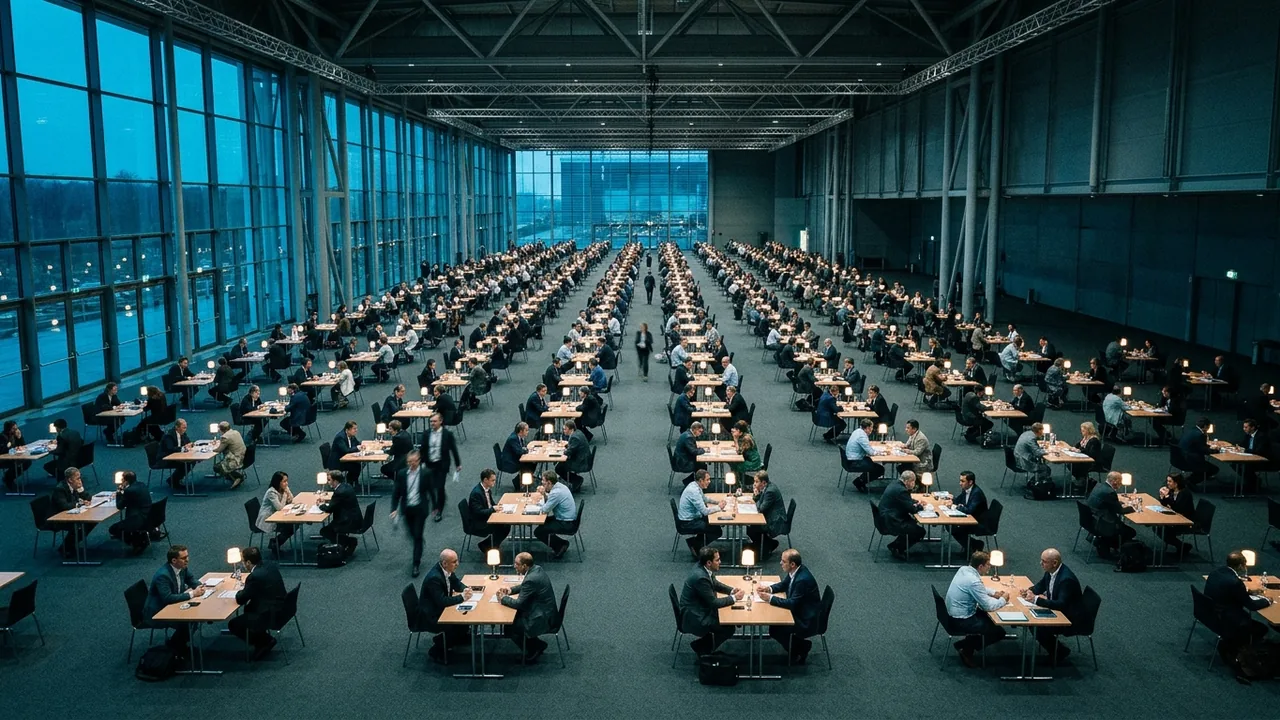
At AD Canada’s 2026 annual meeting in Vancouver, more than 500 members and supplier partners spent four days together and held what the group called “thousands” of one-on-one booth meetings (AD, 8 June 2026). For the organising team, that total is a useful starting point. The next question is how those meetings were distributed across vendors.
A buying group conference is the event where a buying group or cooperative brings its contracted vendors and its member businesses together. Depending on the industry it is called an annual meeting, a vendor show, a member conference or a dealer market. Unlike an open trade show, both sides already belong to the network. The vendors have an agreement with the group. The members, often independent dealers, distributors or retailers who own the group, buy on terms that head office has negotiated.
The appointment programme deserves particular attention because vendors and members have different priorities. This guide explains how to set fair booking rules, what paying vendors should be able to expect and which results to report afterwards.
A large vendor may want more appointments next year, while a smaller vendor needs to know whether its fee was worthwhile. Clear rules and meeting records help head office respond to both.
What makes a buying group conference different?
A buying group conference has several features that affect how you plan the meetings. Three features set it apart:
- Both sides are already in the network: the vendor list is closed, members are known by name, and head office has years of purchasing data. You are not introducing strangers. You are deciding which existing relationships get time.
- Vendors pay, members own: a vendor that pays to attend expects a measurable return. A member that owns the group expects its time to be respected. Your booking rules have to serve both at once.
- The terms are set before anyone arrives: head office negotiates pricing and conditions centrally. At the event, vendor and member talk about range, promotions, stock, training and any show specials that apply during the conference.
This is the mirror image of a reverse trade show, where buyers sit at tables and new suppliers come to pitch for a first contract. Our guide to the reverse trade show covers that format. At a buying group conference the supplier relationship already exists. The open question is how much business each member does with it. The meetings give both sides time to explore how to make use of that agreement.
Here is how three groups in different industries described their 2026 meetings.
| Group | Size | 2026 format | Source |
|---|---|---|---|
| National Alliance of Trade Merchants (NATM), US retailers of appliances, electronics and bedding | More than $8 billion combined buying power (own figure) | Invitation-only vendor conference in Frisco, Texas, 20 to 23 July 2026: 478 registered attendees, 100 vendors and more than 500 scheduled business meetings | NATM press release, 20 August 2026 |
| Millennium Buying Group (MBG), pool, spa and outdoor living | 32 member companies, 72 locations in 24 states, more than $350 million annual sales | 25th annual sales conference in September with a shorter trade show, hosted lunches and breakout sessions | MBG conference page, May 2026 |
| AD Canada (Affiliated Distributors), industrial & safety and building supplies distributors | More than 500 members and supplier partners attended | Four-day annual meeting in Vancouver, May 2026, with thousands of one-on-one booth meetings | AD, 8 June 2026 |
Different trades, same pattern: the scheduled conversation with a named vendor is what members travel for. Millennium Buying Group even strongly encourages attendees to stay on site for the full conference. That request protects the time vendors have committed.
Where popular vendors create scheduling bottlenecks
Those conversations do not spread evenly across the hall. In most groups a handful of vendors carry the core range, and almost every member wants to see them. The rest of the vendor list matters to fewer members. Totals hide that imbalance, as a simple example shows.
Take a group with 300 member businesses and 60 vendors, meeting over two days with a six and a half hour appointment window each day. With 20-minute slots and five minutes to change tables, one vendor table holds 15 meetings a day, or 30 over the event. Each member asks for six meetings.
| Worked example | 10 core vendors | 50 other vendors | Total |
|---|---|---|---|
| Slots available | 300 | 1,500 | 1,800 |
| Member requests (core vendors draw 40 per cent) | 720 | 1,080 | 1,800 |
| Result | 420 requests not met | 420 slots empty | Balanced on paper |
On paper the programme is full. In the hall, 420 member requests go unmet while 50 vendors sit at an empty table for about three and a half hours each. Both groups leave unhappy, and both will tell head office. The overall capacity figure misses the bottleneck at the most popular vendors.
Slot length still matters, and the general capacity maths is in our guide to B2B meetings at events. Here the problem is a different one. It is not how long the slot is, but who gets it.
Booking rules that share out member time fairly
Start by setting booking rules before registration opens. Publish them with the invitation, so that every vendor and member knows how the schedule is built. Six rules cover most situations:
- Member wish lists first: members choose the vendors they want to meet and rank them. The ranking tells you whose request to place first when a core vendor fills up.
- More diaries for core vendors: ask the most wanted vendors to bring two or three staff and give each person a separate diary. In the example above, two extra diaries per core vendor lift their capacity from 300 to 900 slots, enough for all 720 requests.
- A minimum for every paying vendor: set a floor, for example ten confirmed meetings, and fill it with members who have not met that vendor yet. Vendors can request members too, and the meeting goes ahead once the member accepts.
- Recommended meetings from head office: for new listings or range changes, category managers can suggest specific vendor and member pairs. Label them as recommendations so members know why they appear.
- One meeting per vendor per member: no member blocks three slots with a favourite vendor while others wait.
- A visible waiting list: when a core vendor is full, the request joins a list and moves up as soon as a slot is released.
These rules give head office a clear basis for discussing results. A smaller vendor might receive twelve meetings, eight with members it had not met before. A larger vendor can bring additional staff to make more appointments available.
How many vendors per member a programme needs to work at all is a separate question. Our guide to the buyer-to-seller ratio works through that calculation for open events. In a closed network, the ratio is fixed by the membership. The rules decide how it plays out.
What paying vendors should be able to count on
A guaranteed minimum is only the start of what a vendor is paying for. The rest is preparation and follow-up, and most of it costs head office little more than an email:
- a confirmed diary at least two weeks before the conference,
- a short profile of each member they meet, such as region, number of locations and what the member already buys from them, shared within your group’s data rules,
- a clear statement of which show specials apply, when and for whom,
- a meeting report after the event.
Confirmed meetings still fall through. Ask members to reconfirm their diary two days before the event and release unconfirmed slots to the waiting list. Which number you should track for missed meetings, and why it is often reported wrongly, is covered in our article on event meeting no-shows.
One caution applies to joint sessions. Members of a buying group often compete in neighbouring markets, and vendors compete with each other. Keep resale prices, margins and individual business plans out of group discussions, and ask your competition lawyer to review the session rules. This is a practical note, not legal advice.
A planning timeline for the appointment programme
Rules only work if they are in place before the first booking. Working back from the conference, the programme follows this sequence:
The appointment programme of a buying group conference
- 6 months Fix rules and fees Decide booking rules, vendor fee, minimum meetings and table counts, then publish them with the vendor invitation.
- 4 months Confirm vendors and diaries Vendors book their place, core vendors name extra staff, and every staff member gets a diary.
- 10 weeks Open member registration Members register with region, business type and a ranked list of the vendors they want to meet.
- 6 weeks Open vendor requests Vendors request members they want to reach, for example dealers who do not carry their range yet.
- 3 weeks Schedule and confirm Head office builds the schedule, both sides confirm, and waiting lists form for full vendors.
- 2 days Reconfirm diaries Members reconfirm their meetings. Unconfirmed slots move to the waiting list.
- Event days Run the floor Fixed tables, a help desk for changes and the waiting list served on the spot.
- 2 weeks after Report to both sides Vendors receive their meeting report, members a summary of meetings held and show specials used.
Six months sounds early for an annual event. It is not, because the vendor fee and the minimum number of meetings belong in the same offer. A clear offer helps vendors decide whether to take part.
What to report after the conference
Prepare separate summaries for vendors and the group itself, focusing on the results each needs to assess:
- For vendors: meetings scheduled and held, members met for the first time, and orders placed under show specials if head office can see them in its purchasing data.
- For members and the board: the share of members who got their top three vendors, the no-show rate, and how many vendors reached their minimum.
The second list is the one that shapes next year’s rules. If only half the members got their top three, the core vendors need more diaries. If many vendors missed their minimum, the recommended meetings need more weight. Our KPI framework for B2B event matchmaking explains how to define these key performance indicators (KPIs) and compare them across editions.
Some groups add a round of golf the day before the appointments, which gives each vendor four unhurried hours with three members. How to choose those foursomes and connect them to the next day’s meetings is set out in our guide to vendor golf outings.
With Converve, members and vendors register with the details head office needs, such as region, business type and the vendors they want to meet. In a rule-based meeting matrix you decide who may request whom and set meeting quotas per vendor and per member, and meetings are scheduled with a fixed time slot and table once both sides have confirmed. You can see how member organisations use B2B matchmaking on our page for associations.
Frequently Asked Questions
What is a buying group conference?
A buying group conference is the annual event at which a buying group or cooperative brings its contracted vendors and its member businesses together. Members are often independent dealers, distributors or retailers who own the group. The core of the event is a programme of scheduled one-on-one meetings in which vendors and members discuss range, promotions and orders on the terms head office has negotiated.
How is a buying group conference different from a trade show?
At an open trade show, exhibitors meet visitors they mostly do not know. At a buying group conference, both sides already belong to the network: the vendor list is closed, members are known by name, and pricing is negotiated centrally. The organiser’s main task is therefore not attracting visitors but sharing out meeting time fairly between vendors and members.
How do you stop the most popular vendors from being overbooked?
Use published booking rules. Let members rank the vendors they want to meet, ask core vendors to bring extra staff with separate diaries, allow only one meeting per vendor per member, and keep a waiting list for full vendors. In a worked example with 300 members and 60 vendors, two extra diaries per core vendor were enough to meet every request.
Should vendors get a guaranteed number of meetings?
It helps. A vendor that pays to attend wants a measurable return, and a minimum, for example ten confirmed meetings, gives head office a clear promise to keep. Fill the minimum with members who have not met that vendor yet, through vendor requests that members accept or meetings recommended by category managers.
How long should vendor appointments be?
There is no fixed standard. Twenty minutes with five minutes to change tables suits range updates with existing vendors and gives 15 meetings per table in a six and a half hour day. New listings or more complex products may need 30 minutes. Choose one length for the whole programme so the schedule stays simple.
How far ahead should a buying group plan the appointment programme?
Around six months before the event, so that booking rules, vendor fees and minimum meetings can go out with the vendor invitation. Member registration with ranked wish lists typically opens about ten weeks before, and the schedule is confirmed about three weeks before the conference.
Conclusion: share out the time before you share out the tables
A buying group conference already has what open events work hard to find: known vendors, known members and agreed terms. What it lacks, unless you design it, is a fair way to share out the scarce hours with the vendors everyone wants. Booking rules published in advance, extra diaries for core vendors and a minimum for every paying vendor turn that scarcity into a schedule both sides accept.
Next year, head office can answer both vendors before they ask. Would you like to plan the appointment programme for your next member conference? Talk to Converve.