When the American Association of Colleges of Pharmacy invited session proposals for its Pharmacy Education 2025 meeting, one format came with a precise recipe. A World Café slot ran 90 minutes: up to 20 minutes of brief presentation, three 20-minute rounds with one question each, a 10-minute wrap-up, and participants rotating tables after every round. The main points of each round were to be harvested through an online poll and handed to the association. That last line is the one most World Café plans leave out.
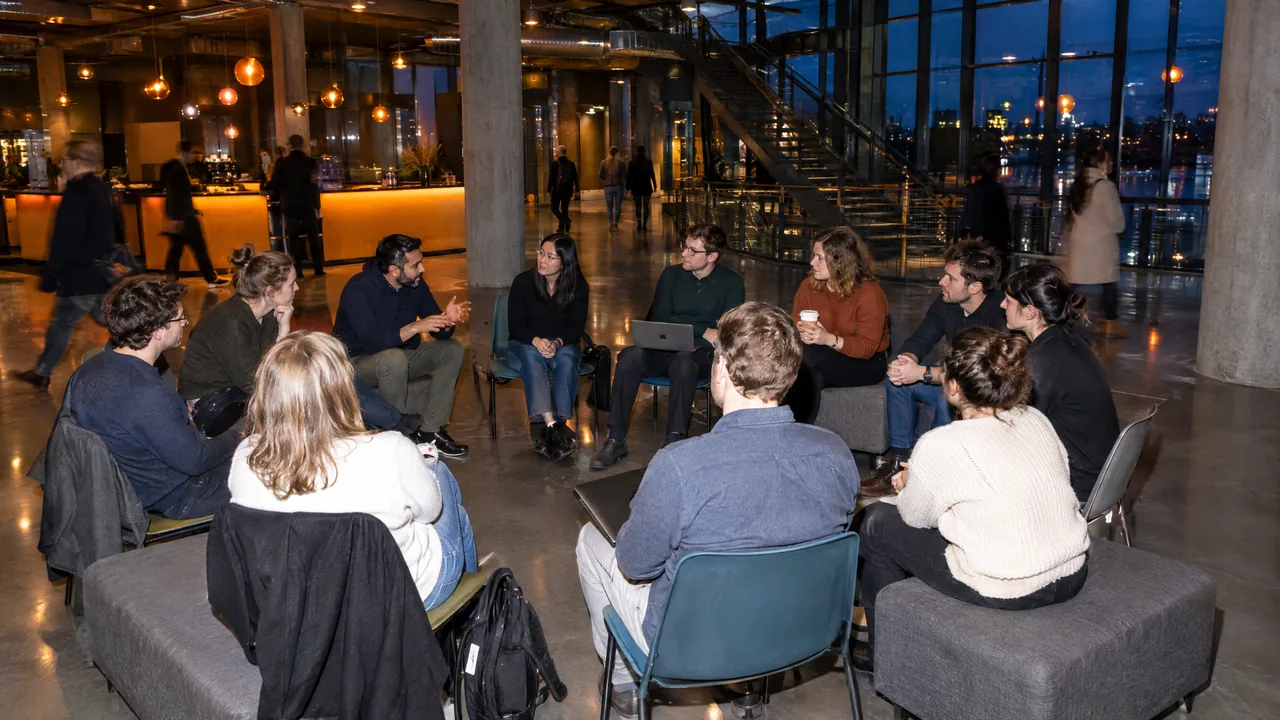
A World Café brings a large group into small table conversations. Guests discuss a prepared question for about 20 minutes, then move to another table, taking ideas with them. A host stays behind to welcome the next group. This guide focuses on the practical preparation for a larger conference: tables and hosts, clear rotation instructions and a way to collect and use the results.
What is the World Café method?
The format was improvised. In 1995, about two dozen business and academic leaders met at the home of Juanita Brown and David Isaacs in Mill Valley, California, planning a morning dialogue in one large circle. Rain disrupted the plan, so they gathered at small tables, wrote on makeshift paper tablecloths and switched tables now and then so that ideas could circulate (The World Café, History). From that morning came seven design principles and a method now used by companies, public bodies, universities and associations.
The World Café Community describes the basic model in five components:
- Setting: small round tables with paper tablecloths and coloured pens, ideally four chairs per table and no more than five.
- Welcome: the host introduces the process, the purpose and the café etiquette.
- Small group rounds: three or more rounds of about 20 minutes, after which people move to a new table.
- Questions: each round opens with a question crafted for the purpose of the event.
- Harvest: insights from the tables are shared with the whole room, at the end or between rounds, often captured visually.
The US Environmental Protection Agency (EPA) describes the same pattern in its public participation guide, with three to five people per table and a typical length of two to three hours. There is no upper limit on numbers. Participedia, the participation research database, lists cafés run by the Financial Planning Association in Australia that ranged from 250 to 4,000 people.
World Café, roundtable, unconference: what is the difference?
Before you count tables, check that the World Café is the right format for your question. Conference programmes often use these labels loosely, and each one does a different job.
| Format | Who sets the topics | Group size | Do people move? | What it produces |
|---|---|---|---|---|
| World Café | Organiser, through prepared questions | 4 to 5 per table, any number of tables | Yes, after every round | Many perspectives on a few questions |
| Roundtable discussion | Organiser, one question per table | 6 to 8 plus a moderator | No | Depth among peers |
| Unconference | Participants, on the day | Varies by session | When they choose | An agenda built from attendees’ topics |
| Panel discussion | Organiser | 3 to 5 speakers, an audience listens | No | Expert positions for an audience |
A roundtable keeps one group at one table for an hour and goes deep; our guide to what a roundtable discussion is covers how to size and seat one. At an unconference, attendees bring their own topics and you only build the grid of rooms and slots, as described in what an unconference is and how to run one. The World Café sits between the two. You set the questions, and the room supplies the range of answers.
When a World Café earns its slot
Demand for formats where everyone talks is rising. In Forrester’s Q1 2026 State of B2B Events Survey, fielded in January and February 2026, two thirds of organisations said they plan more workshops, roundtables and structured networking at their events. For you, that means a block in which every delegate speaks is no longer an experiment. Many of your attendees will expect one.
Take the programme director of a professional society planning its annual meeting for 400 delegates. She wants a World Café on day one, after lunch. The board chair asks her one question: what will we have on Monday morning? Her honest answer depends on what she uses the format for. A World Café works well when:
- the society has a question on which many members hold a piece of the answer, such as member services, a strategy refresh or a new regulation,
- you want hundreds of people talking to people they do not know, early in the event,
- breadth of perspective matters more than depth on any single point.
It works poorly for formal decisions. The EPA guide states plainly that a World Café is not appropriate for obtaining formal comment on proposed plans. Depth has limits too. Löhr, Weinhardt and Sieber (International Journal of Qualitative Methods, 2020) used the method at a project kick-off with 45 participants and compared it with individual interviews and focus groups. Everyone in the room could contribute, but the data was less deep than with either comparison method. So the programme director tells her chair: the café gathers, a smaller group decides afterwards. That is not a weakness. It is the job.
Placement matters as much as purpose. A format in which people stand up and move every 20 minutes is ideal for the post-lunch dip, and a poor fit for the slot just before the gala dinner. Where it sits among keynotes, parallel tracks and breaks is part of conference session types as one programme architecture.
The table maths: how many tables and hosts you need
For the planning example below, allow four moving guests and one fixed host per table. Divide the total attendance, including hosts, by five and round up where necessary. This gives you the number of tables and hosts to arrange before the session.
| Attendees | Tables of five | Hosts | Guests moving each round | Harvest |
|---|---|---|---|---|
| 50 | 10 | 10 | 40 | Each table reports briefly in plenary |
| 150 | 30 | 30 | 120 | Gallery walk of tablecloths, host summarises |
| 300 | 60 | 60 | 240 | Hosts submit key points online, a small team clusters them |
| 500 | 100 | 100 | 400 | As for 300, plus a second room or two sittings |
The last column is the real message. At 80 tables, a report-out of one minute per table takes 80 minutes, which is longer than the three rounds themselves. Somewhere around 30 tables, the harvest has to move from voices in the room to a collection point you set up in advance.
Worked example
A World Café for 400 delegates
Recruiting and briefing 80 hosts
Hosts are the biggest single task of the afternoon. Good candidates are committee members, early career members who would welcome the visibility, chapter leaders and a few staff. They do not need to be experts on the question. The guide to the method by the consultancy FSG describes the host’s job as welcoming each new group, presenting the question, summarising what earlier guests said and sharing the table’s summary at the end.
Allow time for a shared briefing before the session, for example 20 minutes. Cover these four points:
- The three questions, and why the society is asking them.
- The time signal: a chime or a bell, not an announcement over the loudspeakers.
- How to welcome each new group with a one-minute summary of the previous round.
- The capture rule: three key points per round, entered against the table number.
Room and furniture
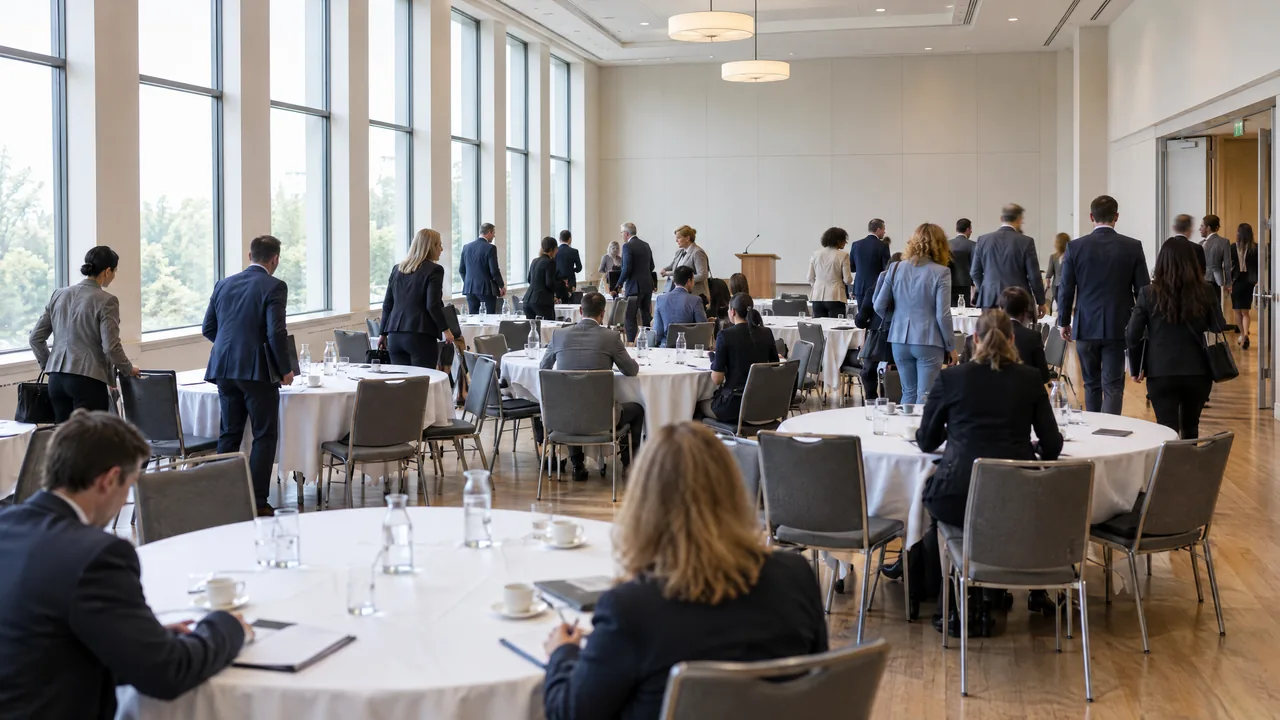
A World Café needs small round tables with chairs all the way round, and aisles wide enough for 320 people to move at the same moment. That is banquet logic, and it takes far more floor than theatre rows. Our guide to event seating styles shows how to work out whether your room really holds 80 such tables once the stage, audiovisual equipment and catering are deducted. If it does not, split the café across two rooms with the same questions.
Writing table questions: three rounds that build
Give each round a specific, open question that can sustain a conversation. “Member engagement” is a broad topic; “What would members miss first if we stopped doing it tomorrow?” gives people a shared starting point while leaving room for different answers.
The EPA recommends starting general and becoming more specific with each rotation. For the society’s annual meeting, that could read:
- Round 1: What will our members need from their society in 2030 that they do not get today?
- Round 2: Which of those needs could we start meeting with what we already have?
- Round 3: What would you personally contribute to make one of them happen?
FSG offers a second route: explore one important question from several perspectives across all rounds. That suits a strategy question with no obvious sub-questions. Whichever you choose, write the questions on a card at every table, so the host does not have to recite them from memory four times.
Test each question once. If it can be answered with yes or no, it is not a table question yet.
The rotation: a rule that really mixes the room
The rotation brings new perspectives into each conversation. FSG’s guide recommends spreading guests across different tables rather than moving each group together. Clear instructions are especially helpful in a large room, where colleagues may otherwise stay together throughout the session.
For a larger group, you can prepare table assignments using a fixed rotation rule:
- Every table has a number, and every guest in round 1 sits in seat 1, 2, 3 or 4.
- In round 2, seat 1 moves one table on, seat 2 moves two tables, seat 3 three and seat 4 four.
- In round 3, everyone moves twice as far: two, four, six and eight tables on.
- After the highest table number, counting continues from table 1.
With at least ten tables, this rule places four guests at every table in every round without repeating a pair of moving guests. This does not include encounters with hosts. Each guest must keep their original number from 1 to 4 and count the second move from their round 2 table. Print the three calculated table numbers on the badge. For smaller groups, check a separate rotation plan.
Table changes at a glance
Four guests start at table 1
Example with ten tables. Each guest keeps their original number for all three rounds.
- Round 1Table 1
- Round 2Table 2
- Round 3Table 4
- Round 1Table 1
- Round 2Table 3
- Round 3Table 7
- Round 1Table 1
- Round 2Table 4
- Round 3Table 10
- Round 1Table 1
- Round 2Table 5
- Round 3Table 3
Read each row from left to right. After table 10, continue counting from table 1. These are the paths of one starting group; every other table follows the same rule.
The rule spreads people out; the round 1 seating is where you choose the mix. Use registration data: delegates from the same organisation at different tables, a spread of sectors, regions and career stages, board members not clustered together. The rule takes care of the rest.
The attributes you mix by are already captured at registration. In Converve, participants keep their organisation, interests, segment and role in a profile, and you set the rules of a rule-based meeting matrix that decides who is suggested to whom. That pays off after the café. A delegate who found someone worth continuing with sends a meeting request, and accepted meetings land in free slots in both agendas without clashes.
The session on the day
With tables, questions and the rotation rule in place, the café itself runs to a fixed beat. The programme director’s version fits a two-hour afternoon slot.
Run sheet
A World Café for 400 delegates in two hours
- 14:00 Welcome and etiquette Delegates are already seated by plan. The facilitator explains the purpose, the questions, the signal and the seat rule.
- 14:10 Round 1 First question, 20 minutes. Hosts make sure every voice is heard and enter three key points.
- 14:33 Round 2 Three minutes to move by seat number. Hosts summarise round 1 in a minute, then pose the second question.
- 14:56 Round 3 Second move, third and most specific question, three more key points per table.
- 15:16 Submit and break Hosts submit their points through a short online form; delegates walk the gallery of tablecloths with coffee.
- 15:40 Harvest in plenary The harvest team presents five to seven patterns; the room adds, challenges and ranks them. Close at 16:00.
Allow enough time for the table changes. Three minutes is the starting assumption here; check the room layout and participants’ access needs before finalising it.
The harvest: decide what you keep before round 1
Decide before the session how the results will be used. You might need a collection of ideas, a ranked list of priorities or open questions for the board. That choice should guide what table hosts record and how the team brings the contributions together.
At 80 tables, the World Café Community’s preferred harvest, a graphic recorder at the front of the room, still needs raw material to draw from. A route that works at this scale:
- Points, not speeches: after each round, hosts enter three key points with their table number in an online form or poll, as AACP asked of its World Café session leaders.
- A harvest team in the break: two or three people cluster the 720 points into recurring themes, disagreements and surprises in about 25 minutes.
- Patterns, not completeness: the plenary hears five to seven patterns, not 80 reports, and the room ranks them.
- Tablecloths as evidence: photograph every tablecloth with its table number visible before the tables are cleared.
Send delegates a summary within a week, with the patterns and what the board will do with them. That second half is what turns an energetic afternoon into a reason to come back. To find out whether delegates valued the format itself, add two or three questions from our post event survey guide. If the café is meant to feed your wider member programme, our guide to association event management shows how one event’s findings carry into the rest of the year.
Frequently asked questions
What is the World Café method?
The World Café is a method for hosting conversation in a large group. Four or five people discuss a prepared question at small café tables for about 20 minutes, then move to new tables while one host stays behind and briefs the next group. After three or more rounds, the insights from all tables are harvested and shared. Juanita Brown and David Isaacs developed it in 1995.
How many people should sit at a World Café table?
The World Café Community recommends four people per table, and no more than five. For a large conference, plan four moving guests plus one host per table and divide your attendance by five to get the number of tables and hosts.
How long does a World Café take?
Most guides recommend three rounds of 20 to 30 minutes. Including the welcome, moves between tables and the harvest, a session runs from 90 minutes to 2.5 hours (FSG); the EPA gives two to three hours as typical. A conference slot of 90 minutes, as at Pharmacy Education 2025, fits three 20-minute rounds.
What does a World Café table host do?
The table host stays at the same table for every round. They welcome each new group, summarise what earlier guests said, keep the conversation on the question, make sure everyone is heard and record the key points. They facilitate; they do not present.
What is the difference between a World Café and an open space?
In a World Café the organiser sets the questions and everyone moves on a fixed rhythm. In open space and other unconference formats, participants propose their own topics and each person decides when to leave a session for another.
Can you run a World Café online?
Yes. Breakout rooms replace the tables, each with a named host and a shared document where every group leaves notes for the next. Everyone moves to a new room at a set time, and hosts bring the results back to the main room.
Preparing the room for a useful conversation
A well-prepared World Café gives many people a chance to contribute. Arrange enough tables, brief the hosts and make the rotation easy to follow. Agree how the results will be collected and shared afterwards, so that the conversation produces something the association and its members can use.
If you want the conversations at the tables to turn into scheduled follow-up meetings, get in touch with Converve. You can also explore how we support associations and their events and our B2B matchmaking.