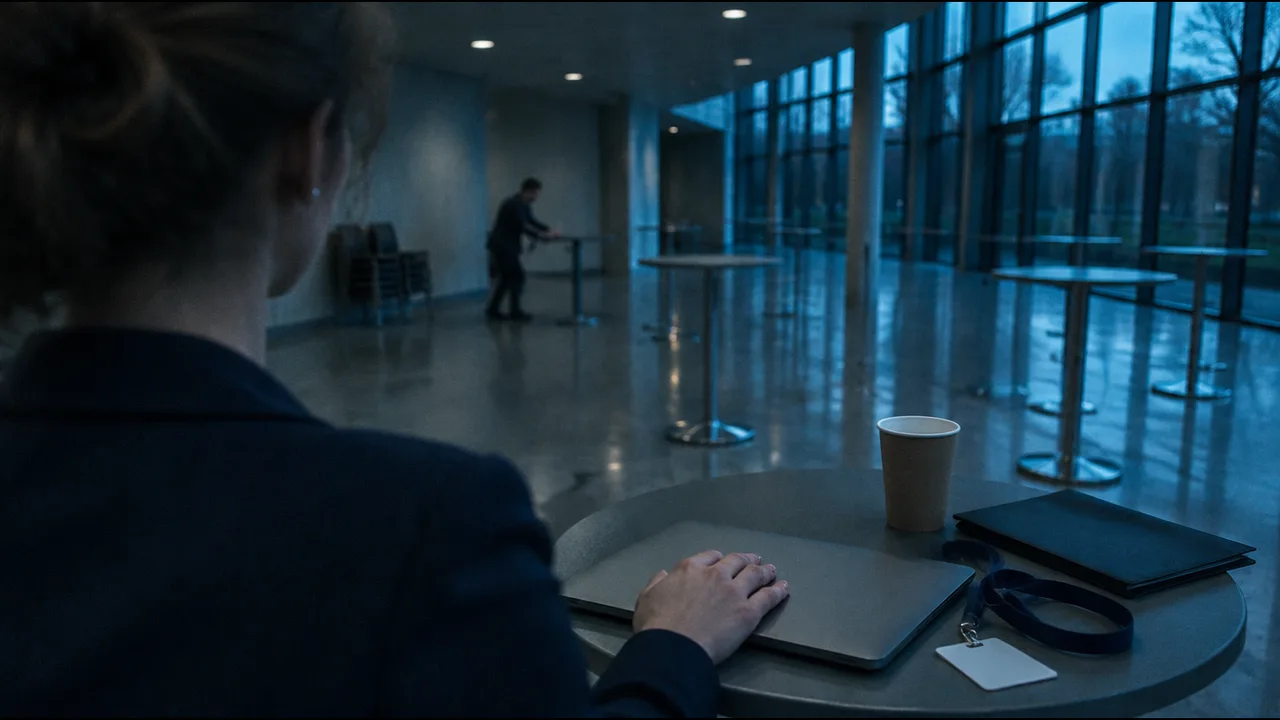
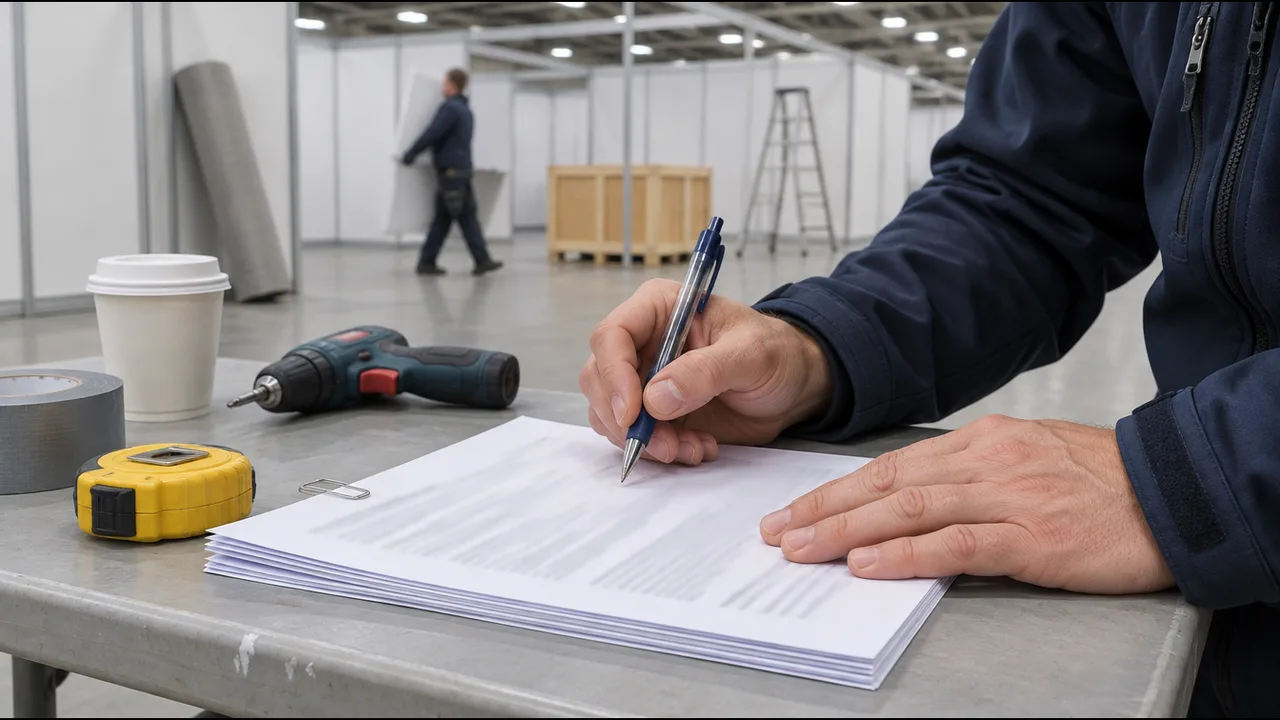
At AAPEX 2026, the automotive aftermarket trade show in Las Vegas, a 400-square-foot booth came with 15 complimentary exhibitor badges. A 350-square-foot booth came with eight (AAPEX 2026 Exhibitor Badge General Information). A difference of 50 square feet changed the allocation by seven badges.
Settle the practical questions before exhibitors book. How many passes come with a stand? What does an extra one cost? Which passes cover co-exhibitors, and how do contractors get into the hall for build-up?
Use your exhibitor terms to explain who can get each type of badge, which areas it opens and when it is valid. Include how you calculate the quota and how exhibitors can request extra badges for their teams.
What an exhibitor badge actually controls
The AAPEX jump is a symptom of something larger. Behind the single word badge sit several groups whose rights differ far more than their lanyards do. Accreditation is the check behind the badge: you confirm which group a person belongs to and release the matching access. For stand staff the exhibitor’s contract usually settles that. For other groups it takes a real check.
| Group | Who belongs to it | When the badge is valid | Typical rule |
|---|---|---|---|
| Stand staff | Employees of the exhibitor working the stand | Show days, often build-up | Free quota by stand size, extra badges for a fee |
| Co-exhibitors | Other companies on a main exhibitor’s stand | Show days | Own quota, a share of the main quota, or not allowed |
| Contractors | Stand builders, AV (audiovisual) technicians, logistics, caterers | Build-up and breakdown only | Separate credential, invalid during opening hours |
| Sponsors and partners | Sponsors, associations, pavilion organisers | As agreed in the contract | Quota written into the sponsorship contract |
| Your own suppliers | Security, catering and registration staff you hire | As the job requires | Own group, managed by you |
Press accreditation runs on proof of journalistic work and is left out here. Everything else follows the same logic. One lanyard, five different rule sets.
Stand staff: scale the quota by space, then cap it
Of those five groups, stand staff generate the most questions. They are the largest group and the one exhibitors feel they have paid for. Almost every show ties the free allocation to stand size, but the curves differ widely.
Free exhibitor badges for a stand of about 400 sq ft (37 m²), 2026
Calculated from the published allocation rules. 400 sq ft is about 37 m². Co-exhibitors are not included.
Two and a half times as many badges for the same floor space is not an accident. It reflects what each event sells. A trade show such as AAPEX wants busy stands in busy aisles. A medical congress such as ESCRS (European Society of Cataract and Refractive Surgeons) lives on delegates who pay for the scientific programme, so it has little reason to hand out free badges generously. Derive your own curve from your format and last year’s staffing, not from another show’s manual.
Three settings decide whether the curve works:
- Base: the smallest stand needs enough badges for shifts and breaks. Three to five badges is the floor in the examples above.
- Step: fine steps, such as two badges per extra 100 square feet at IAAPA, feel fair. Coarse bands are easier to explain, but they create cliffs like the one between 350 and 400 square feet at AAPEX.
- Cap: without a ceiling, a large island stand receives dozens of badges that end up with customers. IAAPA stops at 50.
Write the curve down once. Then stop negotiating it by phone.
Extra badges: set the price for the behaviour you want
Whatever goes beyond the allocation, you sell. The revenue is rarely the point. The price shapes when and how exhibitors order, and the published 2026 rules show four different levers.
AAPEX 2026 raised the price over time: 50 US dollars per extra badge until 26 June, 75 until 25 September, then 100 dollars. The ramp turns the price into a deadline. Exhibitors who register in June pay half of what latecomers pay. Your registration team gets the names while there is still time to print and mail badges.
IAAPA Expo 2026, the attractions industry show in Orlando, charges from 219 US dollars per extra staff badge for members and from 379 dollars for non-members, which ties extra badges to membership. ESCRS 2026 set additional exhibitor badges at 240 euros plus a 20 euro carbon offsetting fee, both excluding VAT (value added tax). At that price an extra badge is a deliberate purchase, not a reflex.
Messe Frankfurt takes a different route. Exhibitor passes are billed on actual usage, up to a maximum amount that is never exceeded. Set-up and dismantling passes are free (Messe Frankfurt exhibitor ticketing guide, accessed 16 November 2026). Exhibitors can order generously without paying for passes that nobody uses, so there is nothing to argue about afterwards.
Late names call for a ramp. Hoarding calls for usage billing. A paid programme calls for a high price.
Co-exhibitors, partners and customers: decide who counts
The allocation settles the simple case of one company on one stand. Arguments start where a stand hosts more than one company, or where a badge begins to look like a free ticket for a customer.
AAPEX 2026 takes the strict line. Exhibitors may not share their space, not even with partner companies. The exhibitor regulations set a fine of 5,000 US dollars per 10 by 10 foot booth. Badges may only be requested for company personnel working the booth, and not for customers, guests or anyone else outside the company. Many organisers choose a softer model and register co-exhibitors with their own fee and a small quota of their own. Both models work. What matters is that the main exhibitor knows which one applies before booking, because the main exhibitor will hand out the badges later.
Customers deserve their own channel rather than a borrowed badge. The AWFS Fair gives exhibitors a personalised registration link they can share with customers and prospects at no cost to either side (AWFS Fair 2027, Invite-a-Customer). The customer arrives as a visitor with a record of their own. The exhibitor badge stays with the people who work the stand.
Sponsors need the same separation. A sponsor with a stand needs staff badges and, separately, places for the guests it invites. Those are two different rights, so write the partner quota into the sponsorship contract and issue it as a badge type of its own. How to place such passes in tiers next to logos and speaking slots is covered in our guide to event sponsorship packages. Extra badges and partner places also belong on your price list next to the space rate, as our article on booth pricing shows.
Contractors and build-up crews: separate credentials for separate days
At 6.45 on the first build-up morning, a stand builder’s crew is waiting at the loading bay with a van full of wall panels. The exhibitor has assigned all its badges to the sales team. A separate pass for contractors would give the crew the access it needs.
Many large shows avoid that morning by keeping contractors out of the badge system altogether. At Breakbulk Europe 2026 in Rotterdam and CWIEME Berlin 2026, contractors and stand builders did not register for a badge at all. Security issued coloured wristbands once the stand details were confirmed. WindEurope 2026 in Madrid went further on the paperwork: contractors had to be registered by 25 March with name, passport number and date of birth. Their wristbands did not open the halls on event days. A contractor needed during the show had to be registered by the exhibitor for a staff pass.
ESCRS 2026 at ExCeL London used a paper contractor pass with fields for name, company and stand number, valid only on the listed build-up and breakdown dates. During the congress itself, the same person needed an official exhibitor badge.
Three rules follow for your own event:
- Issue build-up and breakdown credentials without a quota, but only for those days.
- Make the exhibitor responsible for the names it submits. It knows its contractors, and you do not.
- Treat suppliers you appoint yourself, such as catering, AV and security, as a group of their own.
Passport numbers and dates of birth are personal data, so ask for them only where the venue’s security rules require them.
A wristband costs cents. An idle crew costs the morning.
Names and transfers: the badge belongs to a person
Groups and dates settle half of the problem. The other half is who ends up wearing the badge. Once a visitor ticket costs money, a free exhibitor badge has a market value.
The AAPEX 2026 rules are explicit: badges cannot be transferred, reproduced or resold. Exhibitors found selling badges may be barred from future shows. A rule like that is only as good as its check. Badges registered online in a person’s name make the check possible, because the name on the badge can be compared with the person wearing it.
Changes need a process too. At AAPEX, exhibitors could change names online until badge mailing began. After that, changes were made onsite and the old badge had to be handed back. Additional badges requested onsite required documentation of direct employment with the exhibiting company plus photo ID. That last rule closes the gap where a colleague turns out to be a customer.
From stand contract to badge at the door
- Contract Assign the quota With the stand confirmation, the exhibitor receives its allocation by stand size, including the co-exhibitor rule.
- Registration Collect names The exhibitor registers each staff member by name and buys extra badges at the current price.
- Before build-up Register contractors Stand builders and technicians are listed by name for build-up and breakdown days only.
- Cut-off Freeze online changes Name changes run online until a fixed date, then only at an onsite desk.
- Build-up Check crews at the gate Contractor credentials work on build-up days and stop when the doors open.
- Show day Scan at the entrance The code shows group, valid days and name from one record.
At the entrance: badge, ticket and check-in from one record
The timeline ends at the door, and that is where your rules prove themselves. A badge that reads group, valid days and name from the same record as the registration answers the questions asked at seven in the morning. Is this person allowed in yet? Do they belong to this stand? Is the badge still valid?
Expect exceptions anyway. An exhibitor sends a substitute, a co-exhibitor is added on Friday, a badge was never personalised. These cases belong at a separate desk, not in the fast lane. How many stations and printers you need is a separate calculation, covered in our guide to event check-in and badge printing. Which halls, sessions and meeting rights each badge type should open in the first place is the subject of ticket tiers for B2B events.
Whatever you decide, publish it in one place. The badge section of your exhibitor manual should answer allocation, prices, deadlines and contractor access before anyone asks. If stand staff also scan visitor badges for leads, that is a product of its own, discussed in our piece on lead retrieval for event organisers.
Solution: In Converve’s exhibitor portal, each exhibitor maintains its company profile and registers its stand staff. With Converve’s registration you can also set up tickets per participant group, including exhibitors, with quotas and invitation workflows. Every ticket includes the invitation to register on the event platform, so stand staff appear in matchmaking with a profile of their own. On site, badges are checked by QR code at check-in. How this fits a trade show with a meeting programme is shown on our page for trade shows.
Frequently Asked Questions
How many exhibitor badges does a stand get?
Each organiser sets the number, usually by stand size. For a stand of about 400 square feet (37 square metres), the 2026 rules gave 15 free badges at AAPEX, 11 at IAAPA Expo and 6 at ESCRS. Many shows also set a cap, such as 50 badges at IAAPA Expo 2026.
What does an additional exhibitor badge cost?
It depends on what the price is meant to do. AAPEX 2026 charged 50 to 100 US dollars, rising towards the show. IAAPA Expo 2026 charges from 219 dollars for members and from 379 for non-members. ESCRS 2026 charged 240 euros plus a 20 euro carbon offsetting fee, excluding VAT (organisers’ exhibitor information, 2026).
Do stand builders need an exhibitor badge?
Usually not. Many shows give contractors a separate credential valid only for build-up and breakdown. At Breakbulk Europe 2026 and CWIEME Berlin 2026 this was a coloured wristband issued by security. A contractor who needs to work during opening hours is registered by the exhibitor as stand staff, as WindEurope 2026 required.
Can exhibitors give their badges to customers?
Only if your terms allow it, and most do not. AAPEX 2026 limited exhibitor badges to company personnel working the booth and banned transfer and resale. A better route for customers is a separate invitation, such as the free personalised registration link the AWFS Fair offers its exhibitors.
Do co-exhibitors get their own badges?
That is your decision, and it belongs in the terms before booking opens. Some shows forbid space sharing entirely, as AAPEX 2026 did with a fine of 5,000 US dollars per 10 by 10 foot booth. Others register co-exhibitors with their own fee and a small quota.
What is the difference between an exhibitor badge and accreditation?
The badge is the result, and accreditation is the check before it. You confirm which group a person belongs to and release the matching access. For stand staff the exhibitor’s contract usually settles that. Press, partners and your own suppliers need a separate check.
Conclusion: allocate rights, not cards
On the first build-up day, both gate staff and your exhibitor services team need to know who may enter each hall and when. Record the person’s name, role and valid dates for each badge.
Scale the stand staff quota by floor space, set a cap and publish the price of extra badges. Decide before booking opens whether co-exhibitors and partners get their own quotas. Give build-up contractors passes valid only for build-up and assign each exhibitor badge to a named person. If you want to plan quotas, invitations and check-in for your next show in one system, get in touch with Converve.