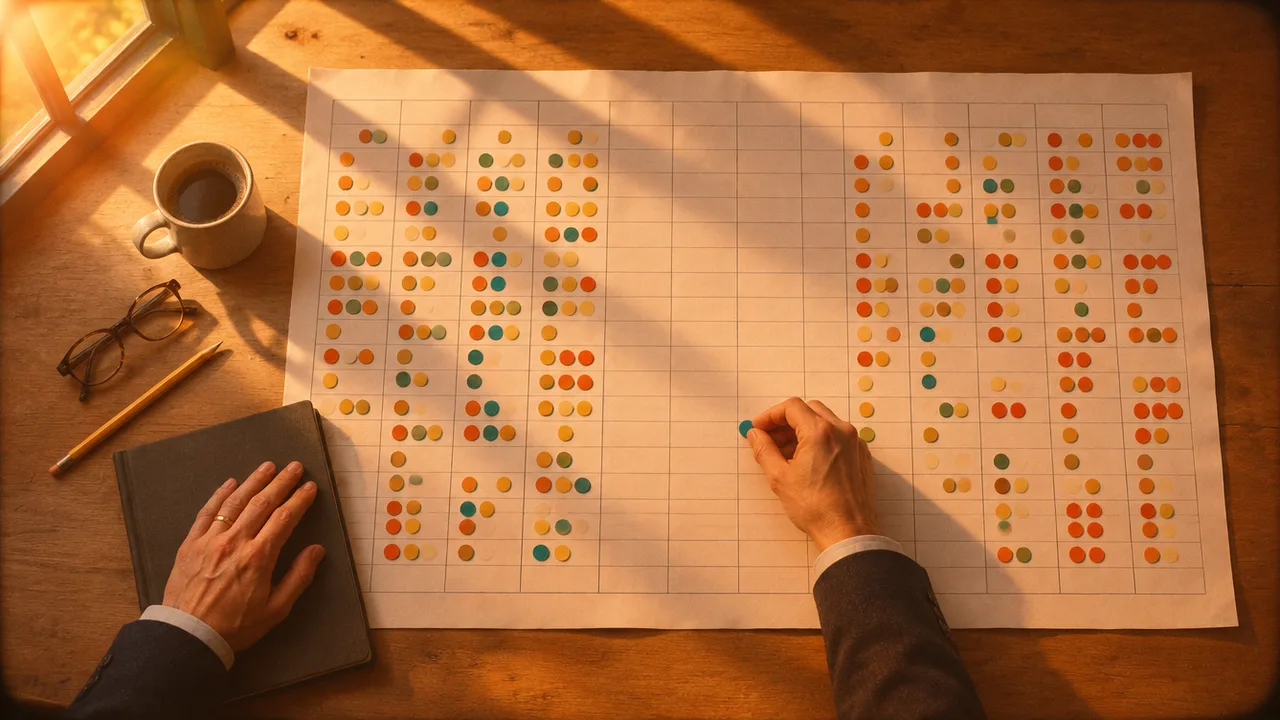
Paul Ingram and Michael Morris of Columbia Business School tracked a mixer for about 100 executives with electronic name badges. Of the guests, 95 per cent said they had come to meet new people. On average, they knew only about a third of the room. Yet about half of their encounters were with people they already knew (Columbia Business School, 2007). The guests did not lack goodwill. They lacked a reason to approach a stranger.
A conference social programme faces the same test on a larger scale. The reception, the city walk, the technical visit and the dinner are often the only hours in which delegates can talk without a session clock. Whether they produce new contacts depends less on the venue than on three decisions: group size, who joins which group and what gives them a topic.
When planning a social programme for an international association congress, decide how to mix the groups as well as where to take them. Track whether delegates meet new people and arrange follow-up meetings, so you can explain what the programme achieved when the treasurer reviews its budget.
What is a conference social programme?
Before that conversation, agree on the scope. A conference social programme covers everything delegates do together outside the scientific or professional sessions: receptions, the conference dinner, guided tours, technical or site visits and hands-on activities. Its purpose is contact between delegates. An accompanying person programme is a separate strand for partners and family members who travel with delegates but do not attend the sessions.
The two strands are usually priced differently. At ICEC 2026, the International Conference on Electrical Contacts in Trondheim, the organ concert and the conference dinner were included in the delegate fee. Accompanying persons paid NOK 1,500 for a dinner ticket, and their daytime excursions were pay-your-own-way (ICEC 2026, social programme page). That split settles an early budget question: what the fee covers and what guests buy on top.
Partner programmes and tours before or after the congress mainly add nights for the destination, as our guide to bleisure for destinations and congress organisers explains. This guide stays with the delegates.
Why the social programme belongs in your networking plan
For delegates, those social hours weigh more than many budgets suggest. Freeman surveyed 4,114 attendees, exhibitors and organisers for its 2025 networking report. Among attendees, 51 per cent said effective networking alone is reason enough to return (Freeman, July 2025). If half your audience comes back for the contacts, the hours designed for contact shape next year’s registrations.
The same research shows why those hours rarely work unaided. Among professionals aged 23 to 46, 40 per cent say networking feels awkward and 30 per cent struggle to start conversations. Nearly half want recommendations on whom to meet before the event (Freeman, 2025). Give these delegates free seating and they sit with the colleagues they travelled with. That is not a failure of character. It is the default.
So plan the social programme like the rest of your networking: who meets whom, in what group size and with what prompt. Formats that answer those questions for receptions and breaks are collected in our list of networking event ideas.
Six social programme formats and what each does well
If the social programme is part of your networking, judge each format on two variables: the size of the group and a shared reason to speak.
| Format | Typical group | What starts the conversation | Best for | Watch out for |
|---|---|---|---|---|
| Welcome reception | Everyone, standing | Badges, hosts who introduce people | Many short first contacts | Delegations forming circles near the bar |
| Conference dinner | Everyone, tables of 8 to 12 | Table neighbours, speeches, awards | A shared moment for the community | Free seating that recreates the office |
| Guided city walk | 15 to 25 per guide | What the guide shows and asks | New contacts in mixed groups | Groups formed by sign-up order |
| Technical or site visit | 10 to 30 | The site itself and its host | Depth between industry, users and researchers | Capacity limits and site safety rules |
| Hands-on activity | 8 to 20 | A shared task, such as cooking or rowing | Small teams that have to talk | Excluding people who cannot join |
| Accompanying person programme | 10 to 30 | Sightseeing and culture | Multi-day congresses with travelling partners | Running parallel to the sessions |
The pattern is simple. The smaller the group and the clearer the shared task, the easier it is for strangers to start talking. The reception and the dinner build belonging. The walk, the visit and the activity build contacts.
The technical visit has one extra advantage: it brings its own topic. After two hours in a water treatment plant or a battery lab, nobody needs an opening line at lunch.
The conference dinner deserves its own decision, because it is usually the largest catering item. Whether a gala, a dine-around in small restaurant groups or a standing reception fits your goals is compared in our guide to planning the conference evening. The rules below apply to the evening too.
Choose the format by purpose and by who can take part
A list of formats invites the wrong first question: what would be nice in this city? Start with the treasurer’s question instead: what will exist afterwards that would not exist without the social programme?
Three checks narrow the choice:
- The share of first-timers. If a third of your delegates are new, small mixed groups matter more than a grand venue; our guide to first-time attendee programmes shows how to pair them with regulars.
- Who can take part. A cycling tour excludes delegates who do not cycle, a wine tasting those who do not drink. A programme that half the delegates skip splits the congress. Offer alcohol-free options, step-free routes and a choice of times.
- The result you will report: new contacts, contacts across a divide such as industry and academia, or a shared moment. Each points to a different format.
Picture a society of transport engineers meeting in Manchester. It can put all 300 delegates on one canal cruise, where most stand at the rail with their own colleagues. Or it can offer four technical visits of 25 people, to a tram depot, a logistics hub, a university lab and a signalling centre, plus guided walks for the rest. Same afternoon, more new conversations.
Build the groups before the coach leaves
Once the format is chosen, the make-up of each group decides what happens inside it. The venue sets the scene; the groups decide who meets whom.
Conversation research sets the limit. Robin Dunbar and colleagues found an upper limit of about four people who can take part in one spontaneous conversation (Dunbar et al., Human Nature, 1995). At a round table of ten, each guest really talks with two or three neighbours. Those neighbours are the decision you can make.
You already hold the data. Delegates entered their organisation, country, role and topics at registration. Turn that into simple, written rules:
- Two per organisation at most: no table, walking group or coach with more than two people from the same employer or university.
- First-timers next to regulars: at least one experienced delegate per group who knows people and introduces them.
- A shared interest, mixed roles: form groups around a topic from registration, then mix seniority, sectors and countries.
- A host for every group: a board member, speaker or member of the local committee who opens with a question from the day’s sessions.
- Countries spread, language shared: spread delegates from one country across groups, but give each group a common working language.
Consider a doctoral researcher from Porto at her first congress. With a sign-up sheet, she joins her supervisor’s tour and spends two hours with her own lab. In an assigned group, she walks next to an industry engineer working on her thesis problem. They agree to meet at the poster session next morning.
Announce the mixing openly: “We mix the groups so you meet colleagues from other organisations.” Most delegates read that as a service, not a rule. If your hosts need openers for sceptical professionals, our icebreakers for business networking offer tested examples.
Put the social programme early in the congress
Well-mixed groups also need the right moment. A sensor study at a scientific conference found that most connections were established on the first day. On the following days, delegates filtered them, and about half of the contacts changed from one day to the next (Génois et al., arXiv, 2019). A contact made on day one can be renewed in a session, a coffee break or a scheduled meeting. A contact made at the farewell dinner ends at the airport.
Two timing rules follow:
- Hold the welcome reception on the evening before or the first evening, so that first contacts happen early.
- Keep delegate tours out of session time. Parallel excursions shrink both the tour and the session. Only the accompanying person programme should run during sessions.
How sessions, breaks and social time fit into one agenda is shown in our guide to conference agenda planning. For the social programme itself, this sequence works backwards from the follow-up you want to report.
From the registration form to the follow-up meeting
- 6 months Fix purpose and formats Decide what each programme point should produce, then book guides, venues and site hosts with your local partners.
- Registration Ask the right questions Collect organisation, country, role, topics, first-time status, dietary and access needs, and accompanying persons.
- 4 weeks Assign the groups Apply your mixing rules and send each delegate their group with the confirmation email.
- 1 week Brief the hosts Give each group host the list of names, two opening questions and the plan for follow-up.
- Day one Hold the first mixer Run the welcome reception or first evening with hosts who introduce people to each other.
- Day two Turn contacts into meetings Delegates who met in the evening book a time to continue the conversation.
- 2 weeks after Measure and report Survey new contacts, count follow-up meetings and report the result to the board.
What a social programme costs per delegate
After timing, the treasurer will ask about money. Prices vary with city and season, but published figures show the order of magnitude.
Three published prices around the social programme
Catering is where costs keep rising, so a three-course dinner for everyone is usually the most expensive hour. Guided formats are cheaper than many assume. The Association of Professional Tourist Guides (APTG) lists London half-day tours from £218, which is about £11 per head for a group of twenty before entrance fees and transport. Exclusivity drives the bill.
That is why the treasurer deserves a better unit than cost per head. Compare formats by cost per new contact. Suppose a dinner at £70 per guest leaves each delegate with one new contact, while a technical visit at £30 leaves them with three. For a networking goal, the visit is the better buy, even if the dinner makes the better photo. Count contacts, not courses.
Let local partners carry the logistics
Prices like these rarely come from your own spreadsheet. Three local partners supply them:
- A destination management company books guides, coaches, venues and site visits. Brief it with your goal and mixing rules, not only the budget.
- The convention bureau is usually neutral and often free. It opens doors to labs, companies and venues that rarely host groups.
- At association congresses, the local organising committee finds social programme venues and arranges technical visits through its networks.
How to tell whether the social programme connected people
Ask delegates about the contacts they made and whether they followed them up. Four measures can help you assess the programme.
- Turnout: the share of registered delegates who actually came, per format. A low share points to the wrong time or the wrong format.
- New contacts: ask “How many people did you meet for the first time at the social programme?” and “How many will you stay in touch with?”. More wording is in our post-event survey questions.
- Follow-up meetings: meetings booked between delegates after a social event, during the congress or in the weeks after it.
- Contacts across the divide: if you wanted to connect industry and academia, count those contacts separately.
Follow-up meetings say the most, because they show what happened after the first encounter: people met on Tuesday evening, met again on Wednesday, and some now work together. That is the sentence the treasurer can take to the finance committee.
Solution: Converve picks up where the social programme ends. Delegates find each other on the event platform and request a meeting for the next congress day. A rule-based meeting matrix defines which participant groups may request meetings with which, and every confirmed meeting gets a time slot in the delegate’s agenda. More on our B2B matchmaking page.
Conclusion: plan the groups, not just the venue
Choose activities that give delegates a shared interest and that they can comfortably take part in. Use registration details to mix the groups, schedule the first reception early and ask whether new contacts led to further conversations or meetings.
If you want contacts from your next social programme to turn into scheduled meetings the following day, get in touch with Converve. More on how associations use the platform is on our page for associations.
Frequently Asked Questions
What is a social programme at a conference?
It covers everything delegates do together outside the sessions: receptions, the conference dinner, guided tours, technical or site visits and hands-on activities. Its purpose is to give delegates time and a reason to meet people they do not yet know.
What is the difference between a social programme and an accompanying person programme?
The social programme is for delegates. The accompanying person programme is for travelling partners who do not attend sessions, so it often runs during session time. At ICEC 2026 in Trondheim, the dinner was included in the delegate fee, while accompanying persons paid NOK 1,500 (ICEC 2026).
When should the social programme take place?
As early as possible, ideally on the evening before or the first evening. A sensor study at a scientific conference found that most connections are established on the first day and then filtered (Génois et al., arXiv, 2019). Contacts made early can be continued in sessions, breaks and meetings.
How do you stop delegates from staying with their own colleagues?
Assign groups and tables instead of relying on free seating or sign-up order: at most two people per organisation, first-timers next to regulars, a shared interest and a host per group. Without such rules, guests at one mixer had about half of their encounters with people they already knew (Columbia Business School, 2007).
How much does a conference social programme cost?
It depends on city, season and exclusivity. Meetings cost about 263 US dollars per attendee per day in 2026, with food and beverage a main driver (GBTA and ALTOUR, 2026). Guided formats are cheaper per head: a professional half-day guide in London starts at £218 for the group (APTG, 2025/26).